English
 Español
Content
Picture a maintenance bay where a technician has to move a 900 pound gearbox from a storage skid onto a workbench. Two people can manage the lift with a lot of effort, but one person with a hydraulic lift table cart can do the same job in under a minute. The cart rolls under the skid, the pump raises the platform to bench height, and the technician slides the gearbox into place without bending or straining. That is why lift table carts have become standard equipment in workshops, warehouses and assembly plants. The payoff is not just safety; it is also speed, because fewer people and fewer forklift trips are needed for every positioning task.
A hydraulic lift table cart is a wheeled scissor lift with a platform mounted on top and a hydraulic pump built into the frame. It is designed to raise a load by a controlled amount, hold it at a chosen height, and move it across a flat floor. In material handling equipment terms, it sits between a pallet jack and a stationary lift table, offering the height adjustment of a lift plus the portability of a cart.
The working principle behind the lift table cart
The cart uses a hand pump, usually worked by a foot pedal with a long handle, to push hydraulic oil into a cylinder. As oil enters the cylinder, the piston extends and drives a set of scissor arms upward, raising the platform. A release valve, opened slowly through a small lever or pedal, lets oil flow back to the reservoir and lowers the platform in a controlled way. The entire assembly is mounted on casters, with swivel wheels at the pulling end and rigid wheels at the other end for stable steering. This simple hydraulic circuit is the reason these carts are reliable, affordable and easy to maintain.
What to check before you buy a hydraulic lift table cart
Buying a lift table cart is not complicated, but a few specifications determine whether it will fit the job for years. The four numbers that matter most are rated capacity, lifting travel, lowered height and platform size. The table below shows typical ranges found in the market and what each one means on the shop floor.
| Specification | Typical range | Effect on use |
|---|---|---|
| Rated capacity | 500 lb to 2000 lb | Sets the maximum load the cart can lift repeatedly |
| Lifting travel | 24 in to 48 in | Defines how far the platform rises above its lowest position |
| Lowered height | 6 in to 16 in | Determines whether the platform slides under pallets or low skids |
| Platform size | 24 x 36 in to 48 x 72 in | Matches the footprint of your heaviest and widest loads |
| Wheel type | 5 in swivel casters plus rigid wheels | Controls maneuverability and stability when moving a load |
| Operating system | Foot pump or manual handle pump | Affects how fast the platform rises and how much effort is needed |
Rated capacity classes and what they mean
Rated capacity is the first specification to verify, because it determines whether the cart can handle your actual loads. The chart below ranges from 500 lb compact carts to 6000 lb industrial units, showing where most workshops fall on the scale. A good rule is to select a cart whose rating is at least 25 percent above the heaviest single load you plan to move. This reserve protects the hydraulic seals, the scissor pins and the platform welds from operating at their absolute limit. It also gives you flexibility for future jobs, since workloads tend to grow over time. In practice, 1000 lb and 2000 lb carts cover most machine shop and maintenance applications.
The rated capacity tells you how much weight the cart can lift, but it does not tell you how long the cart will survive at that limit. A cart rated at 1000 lb will last longer if most jobs stay around 800 lb, simply because the hydraulic seals and the scissor joints run within a comfortable stress range. The chart above shows the common capacity classes, and most buyers settle on a model that covers their heaviest load plus about 25 percent of reserve. A 500 lb cart suits light fixtures and small tooling, while a 2000 lb model is a better choice for palletized parts and maintenance work. Going bigger than needed costs more in price and floor space, so the goal is to match the chart to your real workload.
Choosing the right type for your application
Manual or electric: what the comparison really shows
Once you know the capacity and height you need, the next decision is whether a manual pump cart or an electric lift table fits your operation better. The radar chart below compares both types across six criteria that appear again and again in buyer evaluations.
The radar comparison plots six criteria that matter most to buyers, scored from zero to one hundred. The manual hydraulic lift table cart leads on mobility and cost, because it carries no battery or motor and can be pushed around like a hand truck. The electric lift table wins on precision and safety, since the motorized lift is controlled by a button and includes stronger overload protection. The two shapes intersect at several points, which shows that neither type is universally better. The deciding question is how often the platform rises in a typical shift. If lifting happens a few times a day, the manual cart is simpler; if it happens hundreds of times, electric is worth the added cost.
Platform options and load positioning
The platform surface changes how easily you can position a load once it is raised. A flat platform is adequate for boxes, crates and dies that sit directly on the steel deck. A tilting platform helps when you need to tip parts toward a machine bed or a conveyor. A roller top platform allows a heavy item to be pulled off the cart sideways instead of being dragged across the edge.
For loads that need extra height, a double scissors design provides more lifting travel while keeping the platform stable at the top of the stroke. Within our product range, the SP series manual lift table covers standard workshop tasks, the SPS series double-scissors manual lift table handles taller lifts, and the SJZ series electric lift table suits powered, frequent operation. When choosing between them, review the specific working environment and the height you need to reach, since that influences both the scissor geometry and the wheel layout. For further detail, our guide on choosing the right double-scissors manual lift table walks through the main selection steps.
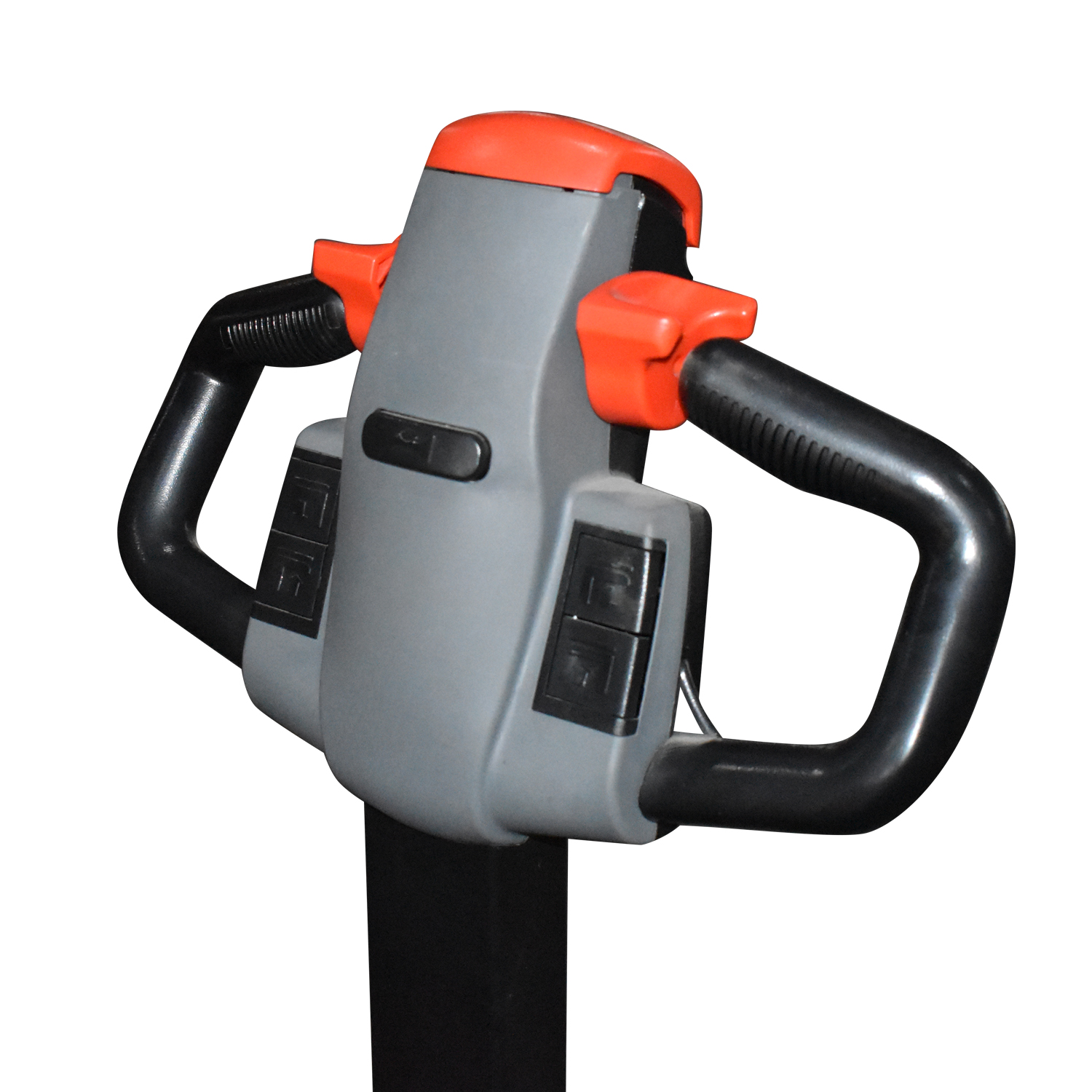 Wholesale Electric Lift Table-SJZ Suppliers, OEM/ODM Company - Hangzhou Giant LiHangzhou Giant Lift Co., Ltd. is China wholesale Electric Lift Table-SJZ suppliers and OEM/ODM company, details: Self-Propelled Electric ...View Product →
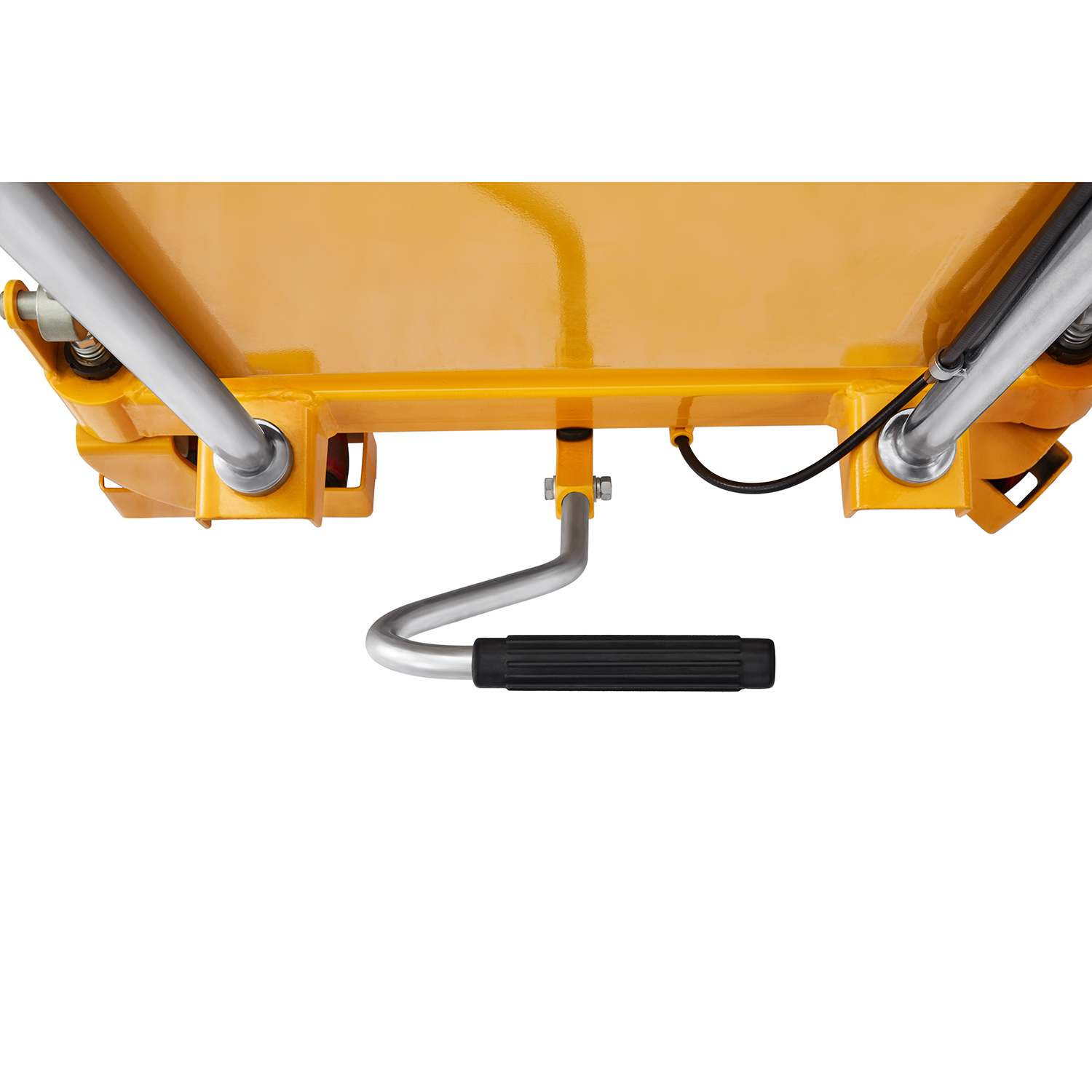 Wholesale Double Scissors Manual Lift Table-SPS Suppliers, OEM/ODM Company - HanHangzhou Giant Lift Co., Ltd. is China wholesale Double Scissors Manual Lift Table-SPS suppliers and OEM/ODM company, details: SPS150/SPS...View Product →
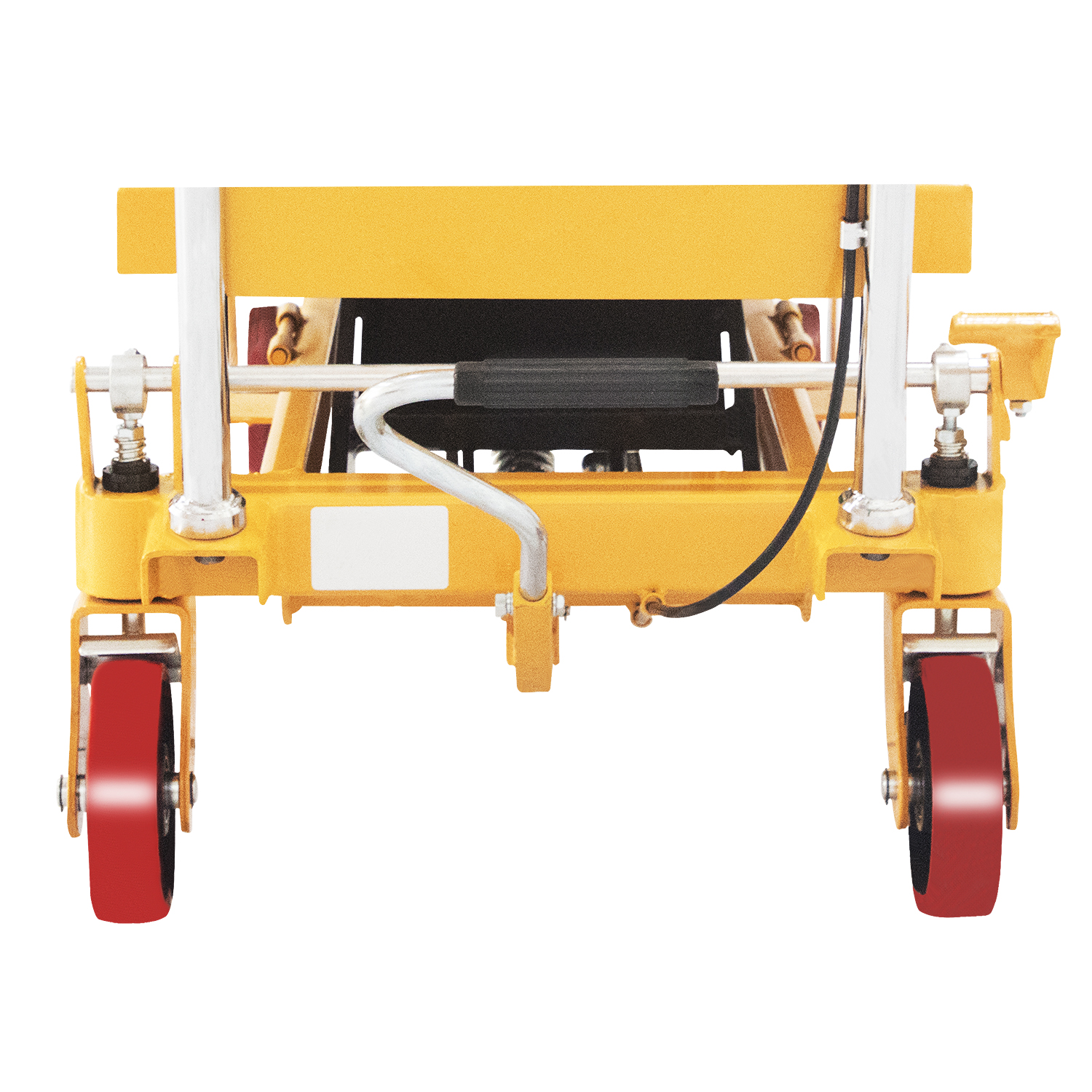 Wholesale Manual Lift Table-SP Suppliers, OEM/ODM Company - Hangzhou Giant Lift Hangzhou Giant Lift Co., Ltd. is China wholesale Manual Lift Table-SP suppliers and OEM/ODM company, details: SP150/SP300/SP500/SP800/SP1...View Product →
Safety and maintenance that extend the service life
What overload does to the service life
Every hydraulic lift table cart has a rated capacity stamped on its nameplate, and that number is not a suggestion. The chart below shows what happens to the expected service life when a cart is regularly operated above its rating.
The line chart shows how quickly a lift table cart ages when it is overloaded on a regular basis. At one hundred percent of rated capacity, a well maintained cart can serve around ten years in a typical workshop. At one hundred ten percent, that figure falls to about seven years, and at one hundred twenty percent it drops to roughly four and a half years. The curve becomes steeper as the load rises, because the cylinder seals, scissor pins and frame welds all operate beyond their design stress. A small, occasional overload is not catastrophic, but a continuous habit of overloading turns a durable machine into a repair liability. Keeping the heaviest regular job at or below ninety percent of the rating gives the best balance of productivity and durability.
The most common failure points
Even with correct use, a lift table cart will eventually need maintenance. The column chart below summarizes the failure points that appear most often in service records and repair reports.
The column chart ranks the most common causes of early failure in hydraulic lift table carts. Seal wear is the leading issue, followed by oil contamination and leaks, and these two categories together account for about sixty percent of all reported problems. Overload damage comes third, usually in the form of bent scissor arms or deformed platform edges rather than a sudden collapse. Wheel and caster damage is next, caused by rolling a heavily loaded cart over debris, dock edges or rough concrete. Structural fatigue is less frequent, but it is the most dangerous because cracks in the welded frame can appear with little warning. A simple monthly check of seals, oil level, wheel bolts and visible welds catches most of these issues while they are still cheap to fix.
A practical maintenance routine
The good news is that a lift table cart is one of the easiest pieces of material handling equipment to maintain. Following a short routine keeps the pump, the cylinder and the wheels in good condition for many years.
- Check the hydraulic oil level every week and top it up with the grade recommended by the manufacturer.
- Inspect the cylinder seals and hoses for moisture, bubbles or cracks during the monthly check.
- Lubricate the scissor pivot pins and bearings every two weeks with a general purpose grease.
- Test the lowering valve to make sure the platform descends smoothly and stops when the lever is released.
- Tighten the wheel bolts and check the caster bearings for looseness or uneven wear.
- Run a full lift with the rated load once a month and listen for noise from the pump or the linkage.
A simple framework for your final purchase decision
When you compare quotes, it helps to start from the work pattern rather than the price tag. The table below maps common tasks to recommended configurations, and it should be read together with your own measurements of floor space and aisle width.
| Work pattern | Recommended configuration | Suggested capacity |
|---|---|---|
| Occasional positioning of jigs and fixtures | Flat platform, manual pump | 500 lb |
| Frequent die and mold changes in a press shop | Double scissors, tilting platform | 1000 lb |
| Palletized parts and repair work in a maintenance bay | Large platform, heavy duty wheels | 2000 lb |
| Multi shift assembly line with constant lifting | Electric lift, push button control | 1500 lb |
When evaluating suppliers, focus on the hydraulic cylinder, the pump quality and the wheels, because these three components determine most of the long term cost. Ask for the load test certificate and confirm that the rated capacity is documented rather than just painted on the frame. If you are buying for resale or for a regulated market, check that the supplier can review the local standards and test reports with you. Our selection guide on factors to consider when selecting material handling equipment covers the broader context for these decisions.
A hydraulic lift table cart is a proven tool for reducing physical strain and improving throughput in workshops, warehouses and assembly lines. It is not a complex machine, but its value depends on honest capacity selection and a consistent maintenance routine. Buyers who pay attention to the cylinder, the scissor geometry and the wheel quality will end up with a cart that serves them for many years. With more than three decades of experience in lifting and material handling products, our team can help you review the specifications, customization options and compliance requirements before you commit to a model.