English
 Español
Content
- 1 What counts as a pallet stacker
- 2 Rated capacity: what the number on the plate really means
- 3 Lift height: the second number that decides the model
- 4 Manual and hand stackers
- 5 Semi-electric stackers
- 6 Full electric stackers
- 7 Throughput: what changes when the pallet leaves the floor
- 8 Matching the family to the job
- 9 Specification checklist before you place the order
A 1,200 kg pallet of bagged resin, a rack whose first beam sits at 1,900 mm, a top beam at 3,200 mm, and an aisle only 2,300 mm wide. That single combination explains most of the pallet stacker enquiries that reach a material handling supplier, and it also explains why so many buyers end up with the wrong machine. The pallet truck cannot lift, the forklift cannot turn, and the hand stacker runs out of mast halfway up the rack.
The short answer is straightforward. If the load only travels across the floor, a pallet truck is enough. If the load has to be raised onto a rack beam or into a delivery vehicle, you need a pallet stacker, and the choice between manual, semi-electric and full electric is decided by three questions: how high, how often, and how wide the aisle is.
Everything below works through those questions in order, with real capacity and lift-height ranges, a side by side comparison of the three stacker families, and the checks that stop a machine from arriving with the wrong mast, the wrong fork length or a capacity that quietly drops at full lift.
What counts as a pallet stacker
On a warehouse floor the words get used loosely, so it helps to separate three machine types that look similar and behave very differently.
- Pallet truck, also called a pallet jack: raises the pallet 100 to 200 mm, just enough to clear the floor. It moves loads, it never stacks them.
- Pallet stacker: the same fork and tiller format, but with a mast that lifts the load to racking height, typically anywhere from 1,600 mm to 4,500 mm depending on the model.
- Counterbalance forklift: lifts high and travels fast, but needs a wider aisle, a larger turning radius and, in many markets, a licensed operator.
The practical dividing line is the rack beam. A pallet truck can serve floor-level storage and loading docks all day long. The moment a pallet has to sit on a beam above roughly 200 mm, a stacker takes over. Stackers keep the narrow footprint that makes them usable in aisles a forklift cannot enter, and that is the whole reason the category exists.
Because the format is compact, the same machine also handles lorry loading, feeding production lines and lifting goods onto mezzanine floors. Buyers who are used to pallet trucks often underestimate how much of that work a stacker removes from the manual handling budget.
Rated capacity: what the number on the plate really means
Rated capacity is quoted at a specific load centre, usually 500 mm or 600 mm measured from the fork face, and it is not a constant across the lift range. The chart below shows typical catalogue ceilings by family.
The bars show typical catalogue ceilings for each family, not legal limits, and the spread inside each family is wide. A manual hand stacker is most often sold between 500 kg and 1,000 kg, which covers small workshops, retail back rooms and occasional lifting on a low beam. Semi-electric models usually sit between 1,000 kg and 1,500 kg, and they are the common answer for mixed duty in a distribution warehouse. Full electric and counterbalance stackers reach 1,500 kg to 2,000 kg and are built for repeated cycles rather than occasional lifts. On reach and straddle designs the residual capacity falls as the mast rises, so a machine rated 1,600 kg at 500 mm may be limited to well under 1,000 kg at a 4,000 mm lift. That is why a serious enquiry always asks for the load chart rather than the headline figure, and why the pallet weight alone is not enough information to place an order.
Lift height: the second number that decides the model
Once the weight is settled, height decides the mast, and the mast decides the price. The next chart compares how high each design typically goes.
The columns are typical maximum lift heights rather than fixed specifications, and they move in step with the lifting mechanism rather than the brand. A hand stacker normally tops out around 1,600 mm, which suits a single low beam, a workbench transfer or feeding a machine. Semi-electric models commonly reach 2,500 mm, enough for two levels of standard racking. Full electric stackers usually reach 3,000 mm, and reach or straddle versions extend to roughly 4,500 mm because the legs take the load forward of the operator. Two-stage and three-stage masts on special builds can pass 5,500 mm, but they add cost, weight and a longer service interval for the mast chain. When you specify height, add the pallet thickness and a working clearance of at least 100 mm, then check the overall lowered mast height against your doorways and container openings.
Manual and hand stackers
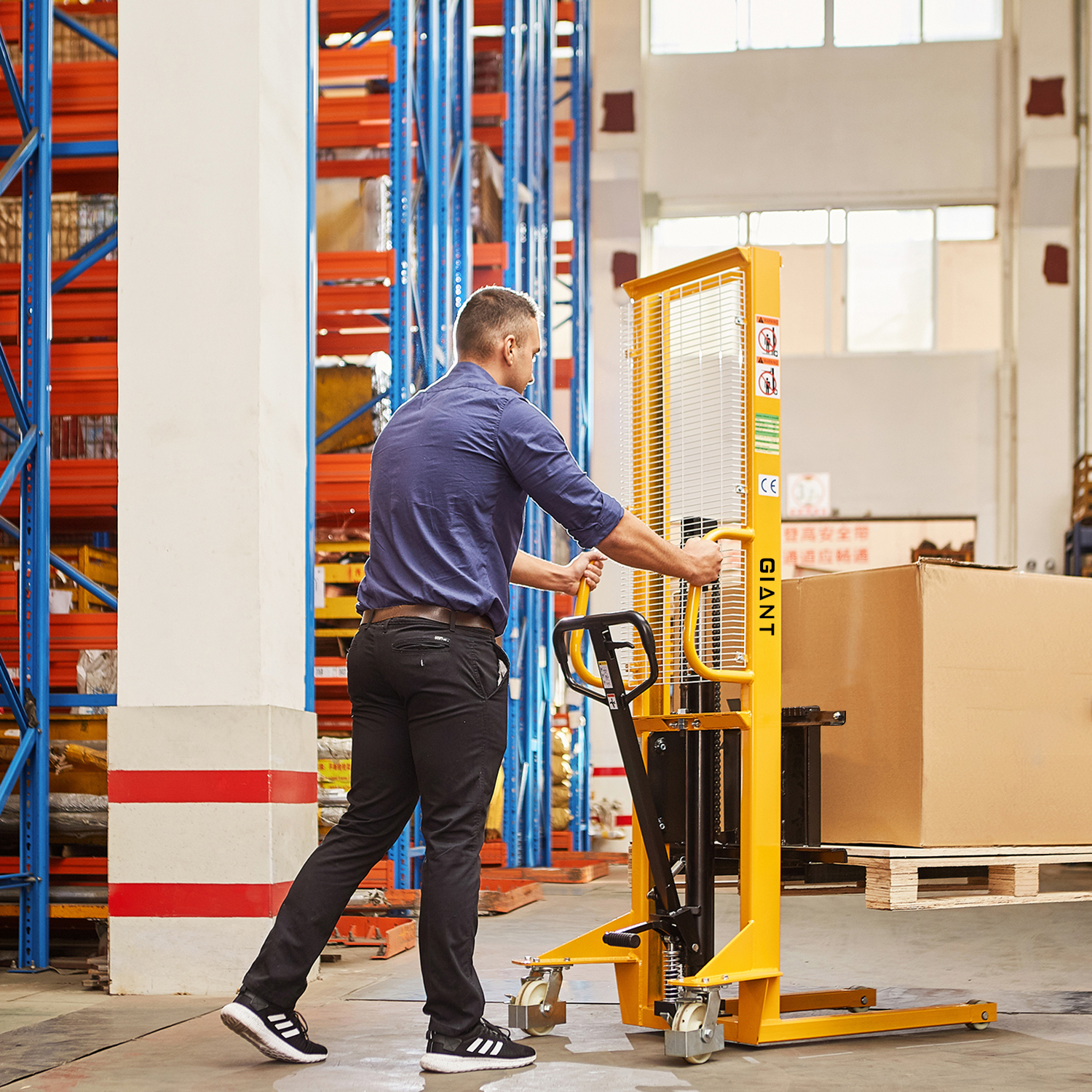
A manual hand stacker does the lifting with a hydraulic pump driven by the operator, usually through a foot pedal or a handle stroke. It is the cheapest way to get a pallet off the floor and onto a beam, and it has almost nothing to go wrong: no battery, no charger, no controller.
The trade-off is the operator. Lifting 800 kg to 1,600 mm by hand takes effort and time, and the cycle repeats every single time. For a workshop that stacks four or five pallets a day, this is a sensible purchase. For a warehouse that handles 200 pallets a shift, it is a bottleneck waiting to happen. Fork length, straddle width and the lowered fork height matter more here than on any other design, because a hand stacker cannot be adjusted later.
 Manual Stacker-SDJASRECOMMENDED PRODUCTS:View Product →
Semi-electric stackers
A semi-electric stacker keeps the manual steering and the hand tiller, but replaces the pump with a battery-driven unit. The operator still walks and still steers, so the aisle requirement does not grow much, yet the lifting effort disappears.
This is the family that most European and North American importers buy in volume, because it covers the middle of the duty range. Charging routines are the main planning item: a lead-acid pack needs a ventilated charging bay and a full charge cycle, while a lithium pack can be opportunity charged during breaks. Neither choice changes the lift height, so the specification work stays focused on capacity, fork dimensions and mast type.
 Semi Electric Stacker-CDD10B-IIIHandle-castor chain assist steering system greatly reduces the labor intensity.View Product →
Full electric stackers
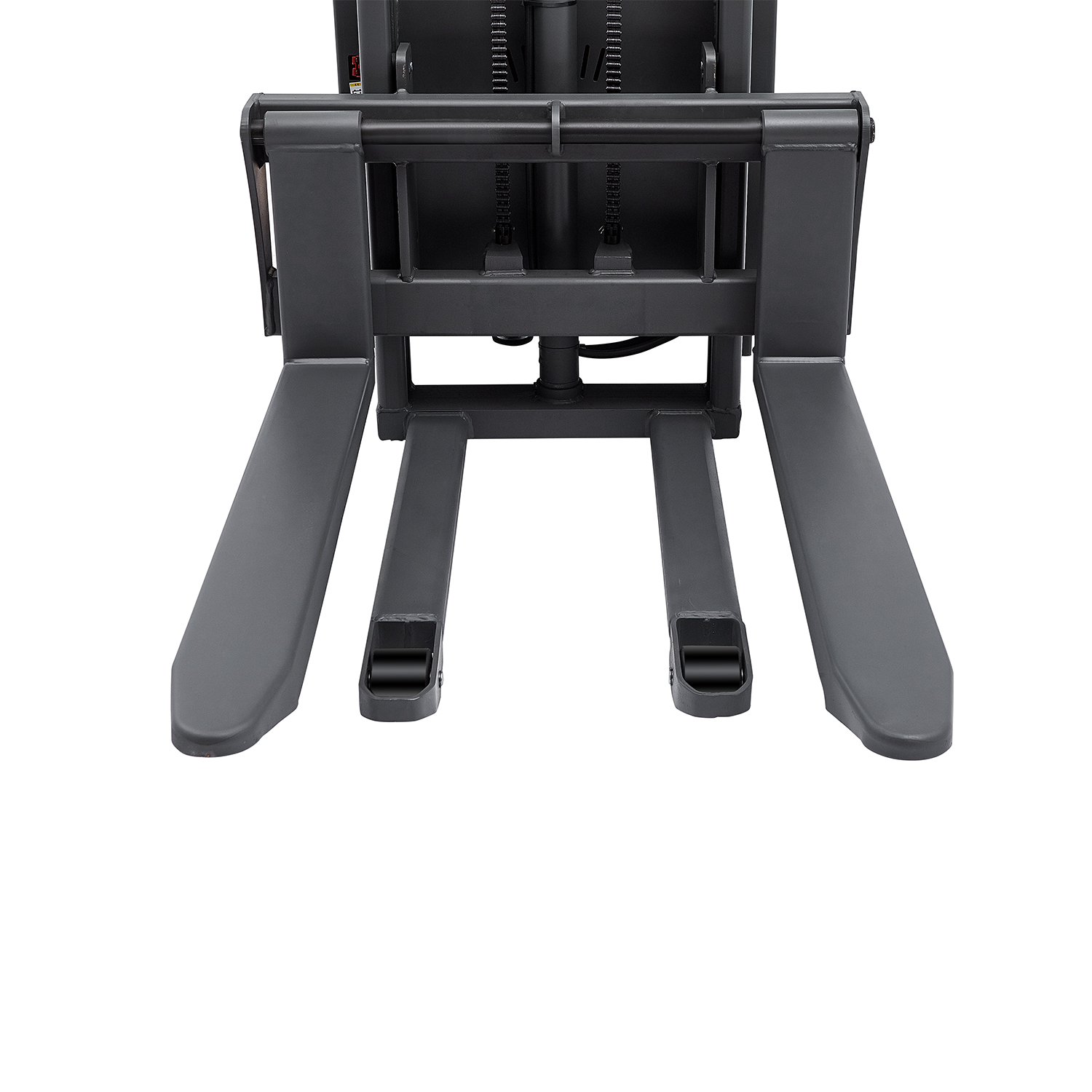
When the pallet count climbs, the drive motor is what saves the money. A full electric stacker powers both travel and lift, so the operator steers a powered unit instead of pushing a loaded one. Over a shift that difference shows up in fatigue, cycle time and the number of operators required to clear a lorry.
Full electric machines also carry the safety electronics that matter at height: speed limitation at raised forks, automatic braking on the tiller, and controlled descent. Self-lifting and off-road variants extend the same platform to uneven yards and ramps. The purchase price is higher and the service requirement is real, but the cost per pallet moved is usually the lowest of the three families once volumes pass a few hundred pallets a day.
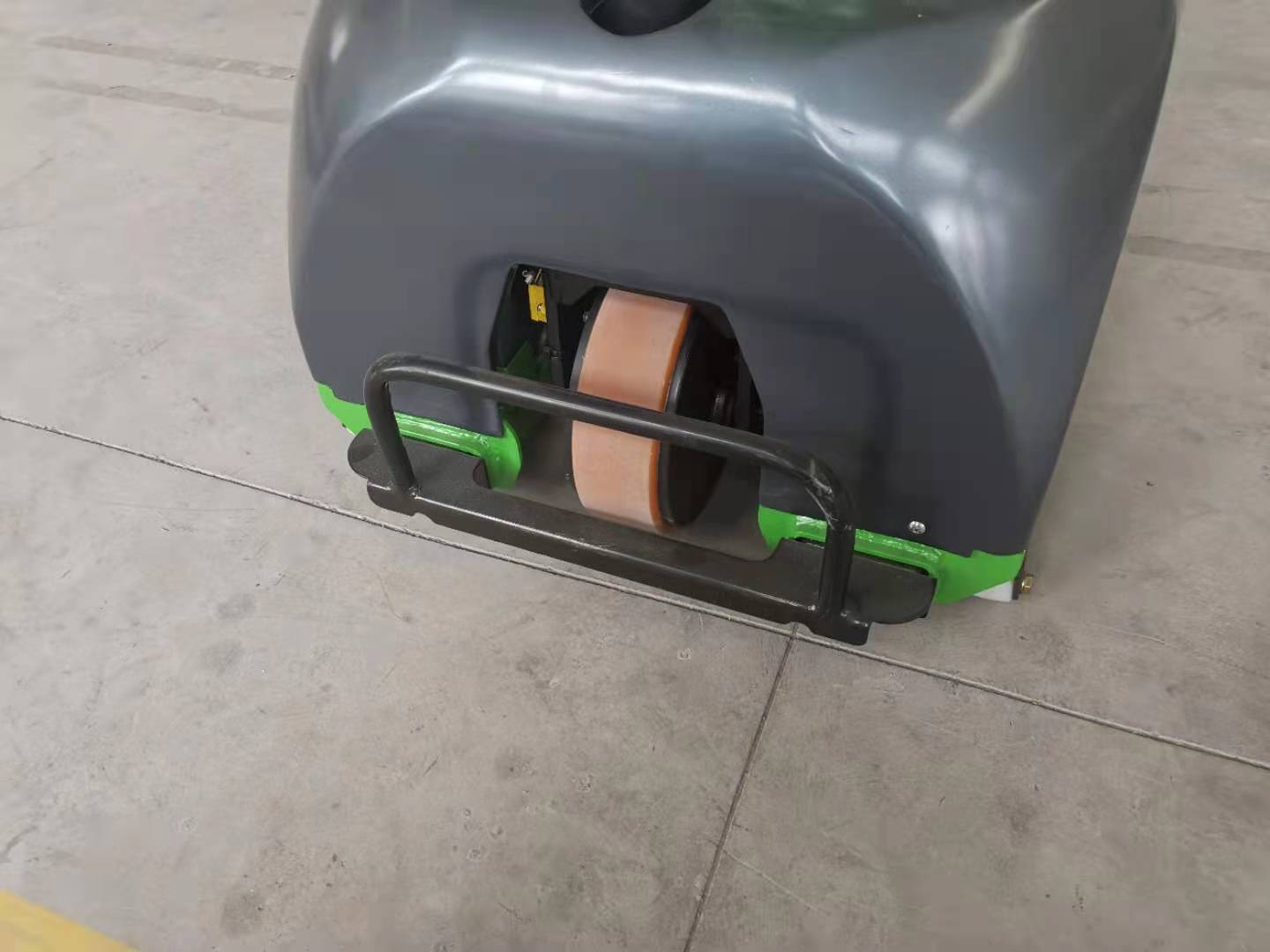 Full Electric Self Lifting Stacker-CDD05BRECOMMENDED PRODUCTS:View Product →
Throughput: what changes when the pallet leaves the floor
Cycle time is where the three families separate most clearly, and the gap widens as daily volumes grow.
The two lines show how handling rate responds as daily volume grows, based on typical duty cycles rather than a controlled test. The grey line, a manual pallet truck working alongside a hand stacker, starts around 12 pallets an hour and improves only slowly, because the lifting effort is the fixed constraint. The red line, a full electric stacker, starts near 20 pallets an hour and climbs past 30 as travel and lift cycles overlap instead of blocking each other. The interesting part is the shape rather than the starting point: the electric line keeps rising while the manual line flattens, so the gap widens exactly when the warehouse is busiest. In practice, labour cost usually dominates the calculation, and a machine that removes six operator seconds per pallet pays for itself long before the purchase price is fully depreciated. The figures shift with aisle length, rack levels and load weight, so treat them as a planning model and confirm against your own time study.
Matching the family to the job
The table below pulls the three families together, and the radar chart after it shows why no single machine wins on every count. If you want to review the whole category in one place, the full stacker range is organised by lifting method and mast type.
| Consideration | Manual hand stacker | Semi-electric stacker | Full electric stacker |
|---|---|---|---|
| Lifting power | Hand pump or foot pedal | Battery-driven pump, manual steering | Battery-driven travel and lift |
| Typical rated capacity | 500 to 1,000 kg | 1,000 to 1,500 kg | 1,500 to 2,000 kg |
| Typical maximum lift | 1,600 mm | 2,500 mm | 3,000 mm and above |
| Aisle width required | 1,800 to 2,200 mm | 2,000 to 2,400 mm | 2,200 to 2,800 mm |
| Operator effort | Highest | Moderate | Lowest |
| Best fit | Occasional lifting, low beams, small workshops | Mixed duty across one or two shifts | High pallet counts, multiple shifts, tall racking |
| Watch out for | Fatigue and slow cycles | Charging bay and battery routine | Higher purchase price and planned service |
The radar compares six practical criteria on the same ten point scale, so the shape of each polygon matters more than any single spike. The grey polygon shows where a manual pallet truck wins: it is easy to maintain, cheap to buy and very comfortable in tight aisles, but it scores low on throughput, rack reach and operator ease. The red polygon shows the opposite profile, with strong throughput, high rack reach and easy operation, and weaker scores on entry cost and maintenance simplicity. The semi-electric shape sits between the two, which is exactly why it is the most common compromise for importers building a mixed range. Read the chart against your own duty cycle rather than as a ranking, because a machine that scores badly on throughput can still be the correct purchase if the site only moves a handful of pallets a day. The only combination that never works is high racking, narrow aisles and manual lifting in the same operation.
Specification checklist before you place the order
Most order errors trace back to a handful of details that are easy to confirm and expensive to fix after the container has sailed. Before signing, how to choose material handling equipment for the job is a useful cross-check against your own requirement list.
- Confirm the real load, including the pallet, the packaging and any moisture pickup, then add a safety margin.
- Confirm the highest beam you must reach, add the pallet thickness, and check the lowered mast height against doorways.
- Confirm the load centre, not just the weight, because residual capacity drops as the mast rises on reach designs.
- Measure the narrowest aisle and the turning area at the rack end, then match the straddle width or the counterbalance format to it.
- Confirm the fork length and width against the pallets actually in use, including any damaged or non-standard ones.
- Confirm the battery type, charging voltage and charging bay ventilation for the destination country.
- Confirm which certification and marking the destination market requires, and ask for the test documentation with the shipment.
- Confirm spare parts availability for wheels, pumps, controllers and mast chains before the first service interval.
Pallet stackers are not a commodity category, even though the machines look similar in a catalogue photograph. The differences sit in the mast, the load chart, the fork dimensions and the drive system, and each of those is decided by the aisle, the rack height and the number of pallets a shift that you already know. Getting those three answers onto paper before the enquiry goes out is the cheapest part of the project and the one that prevents the most expensive mistakes.
Buyers who consolidate stackers with pallet trucks, lift tables, hoists and slings from one supplier generally get a better result than buyers who shop the category in isolation, because the machine can be matched to the rest of the handling flow. Hangzhou Giant Lift supplies manual, semi-electric and full electric stackers alongside the wider lifting and material handling range, with product development and quality inspection teams supporting customised specifications for export markets. Start with the aisle width and the top beam, and the right model usually selects itself.