English
 Español

Content
A 200 litre steel drum of resin weighs around 230 kg. A hand truck moves it along a flat aisle, but nothing about that trip gets the drum onto a 900 mm rack, tips it over a mixer mouth, or holds it steady while a pump is lowered in. Most drum handling problems appear at exactly that point, and so do most wasted purchases. The practical rule is short: choose the drum lifter by drum construction, by whether the drum stays upright or has to be tipped, and by the height and reach the job needs. Capacity, clamp shape and wheel type are checked afterwards, against those three answers.
The Drum Decides Which Gripper Works
Drum lifters grip either the top chime of a closed-head steel drum or the body wall lower down. That distinction matters more than the payload figure on the brochure. A closed-head 200 litre steel drum with intact rolling hoops and a clean chime is the easiest load in the plant. An open-head drum with a lid ring, a plastic tight-head drum, or a fibre drum punishes jaws that were designed for steel.
Wall thickness is the usual failure point. Clamp jaws that concentrate force on a small area will deform a high-density polyethylene drum long before the rated load is reached, and a deformed drum is a leaking drum. If the load is plastic, look for a cradle, a fork support or a body clamp with wide pads rather than a narrow rim grip.
| Drum type | Typical full weight | Workable handling method | Watch out for |
|---|---|---|---|
| Closed-head steel, 200 L | 200 to 300 kg | Rim clamp, below-hook lifter or chime-engaging truck | Bent or worn chime, missing rolling hoops |
| Open-head steel with lid ring | 180 to 280 kg | Body clamp, cradle or fork support | Lid ring is not a load-bearing lifting point |
| Plastic tight-head, 200 L | 200 to 230 kg | Hydraulic drum truck or stacker with fork cradle | Wall flex and creep under narrow jaw pressure |
| Fibre or thin-wall steel | 100 to 180 kg | Drum truck or pallet-based handling | Jaws can crush the shell instead of holding it |
The Four Working Families, and What Each One Solves
Suppliers group drum lifters differently, but the working logic stays consistent. The drum clamp and drum truck range covers most of what a plant, or a reseller, actually sells.
Rim and body clamps
Clamps are attachments: they hold the drum while a crane, hoist or forklift provides the lift. A vertical clamp grips the top chime for upright lifting and lowering; a horizontal clamp turns the drum on its side for pouring or for loading into a mixer. Rated capacity commonly runs from 250 kg to 500 kg per unit, and the practical limit is chime condition rather than steel thickness.
 Drum Clamp-SL Drum Clamp AttachmentDrum Clamp-SL is listed as a drum clamp attachment for crane, hoist or forklift lifting; contact the supplier for specifications and quotation.View Product →
Drum trucks and hydraulic drum trucks
A drum truck is the entry point for floor-level work: two wheels, a nose or hook that engages the chime, and a handle. A hydraulic drum truck adds a pump so one operator can raise the drum to a pallet, a low rack or a draining position without lifting it by hand. These are the units most often bought in single quantities, and the usual complaint after a year concerns wheels rather than structure.
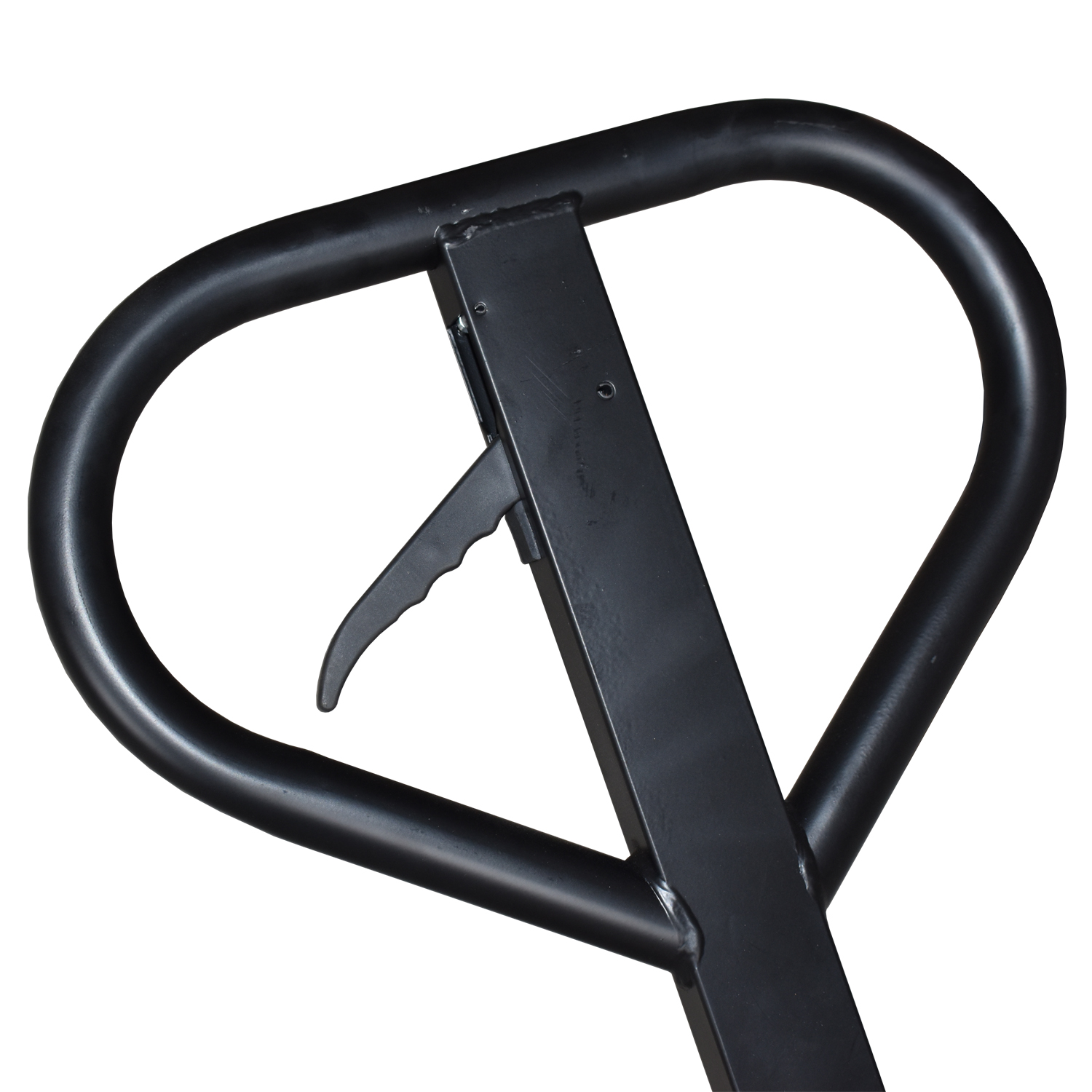 Hydraulic Drum Truck-DT250 for 55-Gallon DrumsAll-steel hydraulic drum truck with 250 kg capacity, rim clamp and 245 mm lift for moving fiber, plastic or steel drums in tight warehouse areas.View Product →
Mast stackers and powered lifters
When drums have to go above waist height, into racking, onto a mezzanine or over the lip of a vessel, a mast-type unit is needed. Manual hydraulic stackers work to roughly 1.5 to 1.6 m; semi-electric and full-electric stackers extend that reach and remove the pumping. Check straddle width against pallet and rack dimensions before ordering, because a stacker that cannot get its legs around the pallet stays in the corner.
 Semi-Electric Drum Stacker-YL350 with 90-Degree TurningSemi-electric drum stacker with electric clamping, lifting and 90-degree turning, maintenance-free battery and C-shaped frame for placing drums horizontally on shelves.View Product →
Below-the-hook and fork-mounted units
Below-the-hook lifters hang from a crane hook and suit process plants where a jib or monorail already exists. Fork-mounted drum handlers slip over forklift tines and convert an existing truck into a drum lifter for the price of an attachment. Both depend on the host equipment, so capacity must be read together with the crane or forklift that carries them.
Capacity, Height and the Margins Buyers Forget
Rated capacity should be compared with the full drum weight plus anything that stays attached, such as a pump, mixer or heavy lid. A 200 litre drum at a specific gravity of 1.2 holds 240 kg before accessories, and users who quote only the nominal drum size are the ones who overload a 250 kg clamp.
- Chime condition: a bent or worn chime reduces grip long before the clamp reaches its rating.
- Lift height: confirm whether the figure refers to the clamp, the drum base or the discharge point. A 1.5 m stacker often means 1.5 m to the fork, not 1.5 m of clearance above a 900 mm rack.
- Drum diameter tolerance: steel and plastic drums vary, so clamp openings are set to a range rather than to one size.
- Aisle and door width: turning a drum truck with a full drum needs more space than pushing an empty pallet jack.
- Floor surface: nylon wheels roll easily on smooth concrete and struggle on a dirty yard; polyurethane runs quieter indoors and is gentler on coatings.
Manual, Hydraulic or Powered: The Effort Question
Decide this by how often the task repeats, not by price alone. A manual drum truck used twice a day is fine; used forty times a day it becomes a reason for sick leave. Hydraulic pumps cut operator effort but add seals and oil to the maintenance schedule. Battery units remove both pumping and pushing, at the cost of charging routines and a higher purchase price. For a warehouse moving twenty to sixty drums per shift, a semi-electric stacker is usually the balanced choice; for one drum a week, a hydraulic truck is enough.
Safety, Checks and the Paperwork Buyers Ask For
- Confirm the clamp still holds the drum if hydraulic pressure drops; mechanical locking or a secondary retention device separates a slowdown from an incident.
- Ask for a load test record and a rated capacity plate fixed to the unit.
- Match the product to local requirements: CE marking and a declaration of conformity for EU buyers, with EN 13155 as the common reference for non-fixed load lifting attachments, and ASME B30.20 as the parallel reference in North America.
- Train operators on the drum type actually used on site, not on a generic video.
- Inspect jaws, pad wear, chains, hooks, pins and wheels before each shift, and replace worn pads instead of adjusting clamp travel.
Sourcing Notes for Importers and Distributors
Drum handling products travel well but are unforgiving on documentation. Three points decide whether a container arrives as a sellable product or as a claim. First, specify the drum standard used in your market, since 200 litre steel, 55 gallon and 210 litre plastic drums differ in rim geometry. Second, put spare parts on the order as a line item: wheel sets, seal kits, jaw pads and return springs are what your customers need in year two. Third, agree the manual and capacity label wording in the destination language. A supplier that consolidates drum lifters with pallet trucks, stackers and slings from one production and purchasing base saves a container slot and a customs entry, and the same logic runs through this material handling selection guide.
Buying a drum lifter stays a short decision when the sequence is kept: identify the drum construction, decide whether it remains upright or tips, then fix the height and the frequency of the task. The remaining choices, capacity margin, clamp pad design, wheel type and spare parts support, follow naturally from those answers. A lifter that matches the drum and the motion gets used every shift; one that matches only the price is parked behind the rack within a month.