English
 Español
Content
- 1 Understanding The Two Main Types Before You Begin
- 2 Key Components To Know Before Operating
- 3 Pre-Use Inspection: What To Check Before Every Shift
- 4 Step-By-Step: How To Use A Manual Pallet Jack
- 5 Using An Electric Pallet Jack: What Changes
- 6 Safety Rules Every Operator Must Follow
- 7 Common Mistakes And How To Avoid Them
- 8 OSHA Compliance And Training Requirements
To use a Pallet Jack, follow five steps: inspect the equipment before each use, lower the forks to ground level and slide them fully under the pallet, pump the handle to raise the load just 1 to 2 inches off the floor, push the loaded jack to the destination at a controlled pace, and then lower the forks and withdraw them cleanly. Most standard pallet jacks can handle loads between 4,000 and 8,000 pounds, and OSHA classifies electric models as Class III powered industrial trucks requiring formal operator certification under 29 CFR 1910.178 (Source: HUPER, How to Use a Pallet Jack: The Complete Safety and Operations Guide; OSHA Education Center, Pallet Jack Safety Training and Certification FAQs). Whether using a manual or electric model, the same core principle applies: keep the load low, push rather than pull, and never exceed the rated capacity.
Understanding The Two Main Types Before You Begin
Before covering operation steps, understanding the difference between manual and electric pallet jacks is essential because each type is operated differently and suited to different tasks.
Manual Pallet Jack
A manual pallet jack uses a hydraulic pump built into the handle. The operator pumps the handle up and down to build hydraulic pressure that raises the forks, and releases a valve to lower them. Manual models are simpler, more affordable, and require no charging or battery management. They are the right choice for small to mid-sized warehouses, short-distance movement, and environments where loads stay within 4,000 to 5,500 pounds (Source: Forklift Academy, How Pallet Jacks Work). Manual pallet jacks are not classified as powered industrial trucks by OSHA, so no formal certification is required to operate them, though safety training is strongly recommended (Source: OSHA Education Center, Pallet Jack Safety Training and Certification FAQs).
Electric Pallet Jack
An electric pallet jack uses a battery-powered motor to raise, lower, and propel the unit, with controls typically operated via a tiller handle with buttons or a throttle. Electric models are used in larger facilities, offer higher load capacities, and reduce operator fatigue significantly over extended shifts. OSHA classifies electric pallet jacks as Class III powered industrial trucks, requiring all operators to complete formal training and certification before independent use (Source: CertifyMe, Electric Pallet Jack Training and Safety Tips). The fork insertion, load verification, and lowering steps are identical to manual operation, but the handle pumping is replaced by button or trigger controls (Source: Forklift Academy, How Pallet Jacks Work).
| Feature | Manual Pallet Jack | Electric Pallet Jack |
| Lifting method | Hand-pumped hydraulic handle | Battery-powered motor |
| Typical capacity | 4,000 to 5,500 lbs | Up to 7,700 lbs or more |
| OSHA certification | Not required (training recommended) | Required under 29 CFR 1910.178 |
| Best use | Short distances, smaller facilities | Longer runs, high-volume warehouses |
| Operator fatigue | Higher over extended use | Significantly lower |
Key Components To Know Before Operating
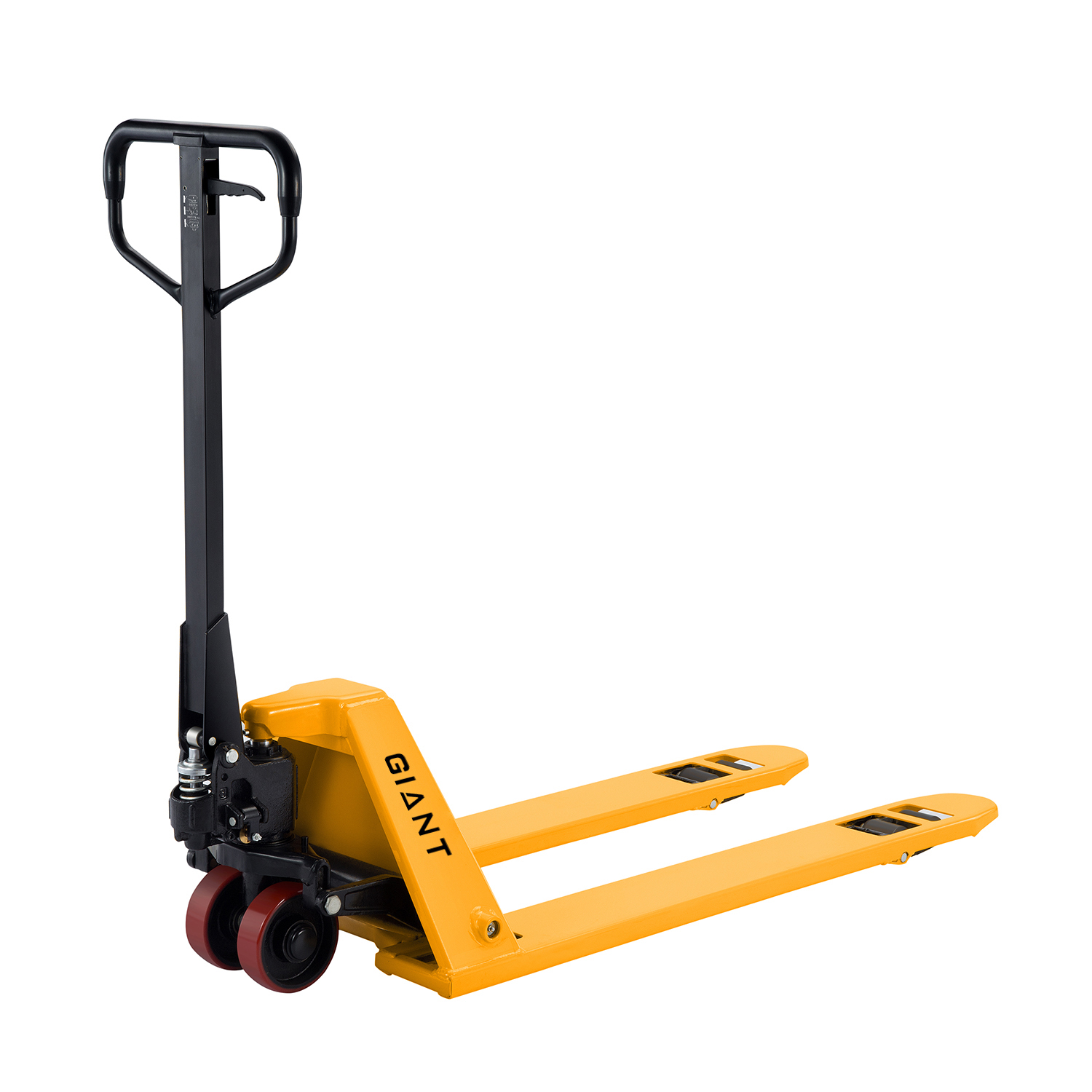
Knowing the name and function of each part of a pallet jack allows operators to communicate clearly about equipment issues and understand the control sequence before touching the machine for the first time.
- Handle or tiller: the steering arm the operator grips at the rear of the unit, used to direct movement and, on manual models, to pump the hydraulic system
- Control lever or release lever: a three-position mechanism typically built into or near the handle, with positions for raising, lowering, and neutral movement
- Forks or prongs: the two parallel horizontal arms that slide beneath the pallet to support the load
- Hydraulic pump: the internal mechanism that converts handle pumping action into the pressure that raises the forks
- Load wheels: small wheels located at the tips of the forks that support the load weight during movement
- Steer wheels: the larger rear wheels that pivot to steer the unit in the desired direction
On electric models, the component list also includes a battery pack, drive motor, horn, and electronic speed controls. Pre-use inspection should confirm that all of these components are functional and that no visible damage, fluid leaks, or loose connections are present (Source: HUPER, How to Use a Pallet Jack).
Pre-Use Inspection: What To Check Before Every Shift
A pre-use inspection is not optional. OSHA's General Duty Clause places responsibility on employers to ensure recognized hazards are eliminated, and sending an operator out with an uninspected pallet jack creates liability for both the business and a safety risk for the operator and surrounding workers.
- Check the forks for bends, cracks, or visible deformation that could cause them to fail under load or fail to enter pallet deck boards cleanly
- Inspect all wheels, both load wheels and steer wheels, for flat spots, cracks, or loose axle hardware that could cause instability during movement
- Test the hydraulic function by pumping the handle a few times to confirm the forks rise smoothly, and test the release valve to confirm they lower at a controlled rate
- Check for hydraulic fluid leaks at the pump housing, cylinder seals, and hose connections, since even minor leaks indicate seal wear that can lead to sudden fork drop under load
- Confirm the handle moves freely through its full range of steering motion without binding or resistance
- For electric models, verify battery charge level, confirm the horn works, and check that all warning lights and control functions respond correctly before loading
If any inspection item reveals a problem, the unit should be removed from service and tagged for maintenance before another operator attempts to use it. Three Sixty Safety notes that if there are any problems with the jack, it should be removed from service and the supervisor notified immediately rather than attempting to continue operation with a compromised unit (Source: Three Sixty Safety, Safe Pallet Jack Operation).
Step-By-Step: How To Use A Manual Pallet Jack
Step 1: Clear Your Route First
Before approaching the load, walk the entire route from the pallet's current location to its destination and remove any obstacles, debris, or hazards. BigRentz identifies route clearance as the second step before any pallet jack operation, noting that it is worth taking the extra time to ensure you do not accidentally drop a pallet due to an obstacle encountered mid-movement (Source: BigRentz, How to Use a Pallet Jack). Look for wet floors, floor drains, gaps in flooring, ramps, or areas of pedestrian traffic that will require slowing down.
Step 2: Lower The Forks And Position The Jack
Stand behind the pallet jack and grip the handle firmly. Move the control lever to the down position to lower the forks fully to the ground. Push the jack toward the pallet and align the forks with the pallet's entry openings. Most standard pallets have openings on two or four sides depending on their construction, so approach from the direction that gives you the clearest line to insert both forks simultaneously (Source: Toyota Material Handling, How to Use a Pallet Jack: Step-by-Step Guide and Safety Tips).
Step 3: Insert The Forks Fully
Push the pallet jack forward until both forks are completely inserted beneath the pallet, with the load wheels at the fork tips resting on the floor inside the pallet opening rather than on the edge of a deck board. HUPER's operational guide states this directly: center the forks completely under the load to distribute weight evenly, and ensure the load is stable and properly stacked before raising (Source: HUPER, How to Use a Pallet Jack). If the forks are not fully inserted, the load will be supported only at its edge rather than at its center of gravity, significantly increasing the risk of tipping when the unit is in motion.
Step 4: Raise The Load Just 1 To 2 Inches
Once the forks are fully inserted, move the control lever to the up position and pump the handle with both hands to raise the forks. The load only needs to clear the floor by 1 to 2 inches, which is sufficient to allow the unit to roll freely. HUPER confirms this clearly: lift the pallet just enough to clear the floor, since keeping the load low maintains stability and reduces the risk of tipping (Source: HUPER, How to Use a Pallet Jack). Before moving, perform a brief stability check by confirming the load is not wobbling or overhanging the pallet unevenly.
Step 5: Push, Do Not Pull
With the load raised, push the pallet jack in the desired direction. All guidance from safety authorities is consistent on this point: always push rather than pull whenever possible. BigRentz explains the physiology: humans are able to push much more weight than they can pull, and excessive pulling can result in back injury (Source: BigRentz, How to Use a Pallet Jack). HUPER adds that pushing keeps the operator's spine straight and uses larger leg and back muscles, while pulling increases the chance of back injury and of being struck by the load if it becomes necessary to stop suddenly (Source: HUPER, How to Use a Pallet Jack). Maintain a steady, controlled pace, keep your body positioned to the side of the pallet jack for maximum visibility, and slow down in advance of turns, pedestrian crossings, and doorways.
Step 6: Lower And Withdraw The Forks
At the destination, position the pallet jack precisely where the load needs to rest. Move the control lever to the release position and allow the forks to lower slowly and evenly until the pallet is fully supported on the floor. Once the load is down, push the jack backward to withdraw the forks completely from beneath the pallet before leaving the area (Source: Toyota Material Handling, How to Use a Pallet Jack). If needed, secure the unloaded pallet with straps before removing the jack.
Using An Electric Pallet Jack: What Changes
The fork insertion, load verification, and lowering steps are identical for electric models. The key operational differences are in how movement and lifting are controlled.
- Use the up and down control buttons or the tiller-mounted throttle to raise and lower the forks rather than pumping the handle
- Use the drive throttle to move the unit forward, maintaining a safe speed especially in high-traffic areas and near pedestrians
- Never exceed safe operating speeds, particularly when cornering or operating near loading docks where floor edges present fall hazards
- Check battery charge before beginning any significant movement task, since a unit that loses power mid-route with a loaded pallet becomes a difficult recovery situation requiring manual intervention
- Use the horn to alert pedestrians when approaching blind corners or working in shared pedestrian and vehicle zones
CertifyMe notes that electric pallet jacks appear simple to operate but carry hazards similar to larger machinery, and that training teaches users how to assess risks, navigate warehouses, and prevent accidents before they happen (Source: CertifyMe, Electric Pallet Jack Training and Safety Tips).
Safety Rules Every Operator Must Follow
The following safety rules apply to both manual and electric pallet jack operation and address the most common causes of pallet jack-related injury and product damage in warehouse environments.
- Never exceed the rated load capacity: overloading a manual jack by even 10 to 15 percent can cause hydraulic seal failure and sudden load drops (Source: Forklift Academy, How Pallet Jacks Work)
- Never use only one fork to move a load: always use both forks to ensure balanced weight distribution and prevent the pallet from tilting under asymmetric support (Source: Three Sixty Safety, Safe Pallet Jack Operation)
- Secure loose items before moving: use shrink wrap or strapping to prevent load shifting during transport, since a shifting load on a moving pallet jack can tip the entire unit (Source: Forklift Academy, Beginner Pallet Jack Training)
- Keep the load low during movement: the 1 to 2 inch ground clearance standard keeps the center of gravity low and reduces tipping risk on uneven surfaces
- Ask for help with heavy or imbalanced loads: Three Sixty Safety specifically recommends asking for assistance when a pallet is extra heavy or when movement up or down an incline is required, rather than attempting it alone (Source: Three Sixty Safety, Safe Pallet Jack Operation)
- Wear appropriate PPE: steel-toed boots protect feet from falling loads and from being run over by the pallet jack's wheels, which are a documented injury risk when operators work alone without a spotter
- Use a spotter when vision is obstructed: if the load blocks your view of the travel path, a second person should guide the operator from the front to watch for obstacles and pedestrians (Source: Three Sixty Safety, Safe Pallet Jack Operation)
Common Mistakes And How To Avoid Them
Even experienced operators develop habits that compromise safety or shorten equipment life. The most frequent errors in day-to-day pallet jack use fall into three categories.
Partial Fork Insertion
Sliding the forks only partway under the pallet is one of the most common loading errors. A partially inserted fork leaves part of the pallet unsupported, shifts the load's center of gravity toward the fork tips, and dramatically increases the risk of the load tilting or falling when the jack begins to move or turns. Always push the forks fully through the pallet opening until the load wheels are resting on the floor inside the pallet's footprint.
Pulling Instead Of Pushing
Operators who pull pallet jacks instead of pushing them expose their lower backs to significantly higher compressive force than pushing requires, and also place themselves in the path of the load if the load shifts forward or the jack accelerates unexpectedly. The push technique keeps the operator's body outside the load's travel path in both directions.
Raising The Load Too High
Some operators raise loads well above the 1 to 2 inch ground clearance recommendation, either to clear a floor obstacle or simply through habit. A higher lift raises the center of gravity and makes the loaded pallet significantly more susceptible to tipping when the unit encounters even small floor irregularities or makes a turn. If a floor obstacle is too large to pass over at the standard clearance height, the correct response is to find an alternate route rather than raising the load higher.
OSHA Compliance And Training Requirements
OSHA's requirements for pallet jack operation differ based on whether the jack is manual or electric, but both types fall under a framework that requires employers to ensure operators are prepared before they work with equipment independently.
Manual pallet jacks are not classified as powered industrial trucks under OSHA standard 1910.178, meaning formal certification is not legally mandated. However, they do fall under OSHA's General Duty Clause, which requires employers to address recognized workplace hazards, making documented safety training a best practice even when not strictly required (Source: Forklift Academy, How Pallet Jacks Work). Electric pallet jacks are classified as Class III powered industrial trucks under 29 CFR 1910.178, requiring all operators to complete formal instruction, practical training, and a performance evaluation before independent operation, with recertification required every three years or after any accident or near-miss (Source: SafetyVideos.com, OSHA Regulations for Pallet Jack Use).
The G-Lift Pallet Jack range is built to support operators working within these compliance frameworks, offering both manual and electric models with clear load capacity ratings, ergonomic handle designs that support correct push technique, and construction quality that holds up under the daily inspection-and-operate cycles required by OSHA-compliant warehouse programs.
.jpg?imageView2/2/w/500/h/500/format/jpg/q/100)