English
 Español
Content
- 1 Why FEM and ISO Classification Determines Lifespan More Than Age
- 2 The Wire Rope Itself Has A Shorter Service Life Than The Hoist Body
- 3 What Shortens An Electric Wire Rope Hoist's Life
- 4 Inspection Schedule That Protects Hoist Lifespan
- 5 Key Components And Their Individual Life Expectations
- 6 How To Maximize The Working Life Of Your Hoist
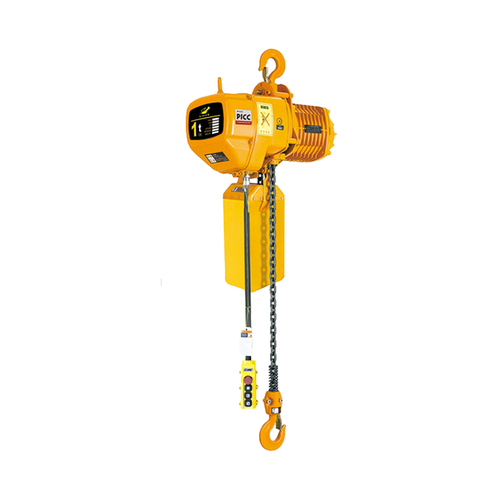
A well-maintained industrial-grade Electric Wire Rope Hoist typically lasts between 10 and 20 years or more in service, depending on its FEM or ISO duty classification, the actual load spectrum it handles, and the quality of preventive maintenance applied throughout its life. Chengdu Weiyuan Lifting Equipment confirms that a high-quality, well-maintained hoist used within its rated duty cycle can last 20 years or more, providing decades of reliable service (Source: Chengdu Weiyuan, What Is the Lifespan of an Electric Hoist). However, the calendar year figure alone is misleading: the correct measure of hoist lifespan in professional material handling is the Safe Working Period expressed in theoretical lifting hours, which is defined at the design stage by the hoist's FEM or ISO classification and varies significantly between duty groups. A lightly loaded hoist in an M3 duty class will outlast a heavily loaded unit in M7 or M8 duty by a wide margin under the same calendar period, even if both are equally well maintained.
Why FEM and ISO Classification Determines Lifespan More Than Age
The most important factor in an electric wire rope hoist's working life is not how many years it has been installed, but how many theoretical lifting hours it has accumulated relative to its design rating. The FEM (European Federation of Materials Handling) and ISO classification systems both define this relationship precisely, assigning each hoist a duty group that corresponds to a specific combination of load spectrum and total running hours over its life.
H-Lift's technical reference on FEM and ISO standards confirms that both systems aim to guarantee a minimum theoretical lifespan measured as Safe Working Period, and guide users on how long a hoist will last under specific load spectrums defined as light, medium, or heavy at given daily operating hours (Source: H-Lift, FEM vs. ISO Standards for Wire Rope Hoists). A wire rope hoist rated at FEM 2m or ISO M5 represents the industry standard for general manufacturing and logistics, offering a balanced mid-level rating for moderate to heavy duty cycles without the excessive cost of a heavy-process crane at M7 or M8 (Source: H-Lift).
How Duty Classification Maps To Lifespan
| FEM Group / ISO Class | Duty Level | Typical Application | Approximate SWP Hours |
| FEM 1Am / ISO M3 | Light | Occasional maintenance, workshops | 3,200 hours |
| FEM 1Bm / ISO M4 | Light to moderate | General fabrication, light production | 6,300 hours |
| FEM 2m / ISO M5 | Moderate | General manufacturing, logistics | 12,500 hours |
| FEM 3m / ISO M6 | Moderate to heavy | Steel warehousing, machining | 25,000 hours |
| FEM 4m / ISO M7 | Heavy | Foundries, high-cycle heavy industry | 50,000 hours |
These theoretical hours represent the design life of the hoist's mechanical components under the specified load spectrum. When accumulated running time approaches the SWP limit, a competent engineer must perform a detailed inspection to determine whether the hoist can continue in service or requires replacement of major components. R&M Materials Handling confirms that FEM is one of the most stringent classification systems available, meaning a hoist certified to FEM standards is held to some of the highest safety and durability standards in the industry (Source: R&M Materials Handling, Crane and Hoist Duty Cycle Classifications).
The Wire Rope Itself Has A Shorter Service Life Than The Hoist Body
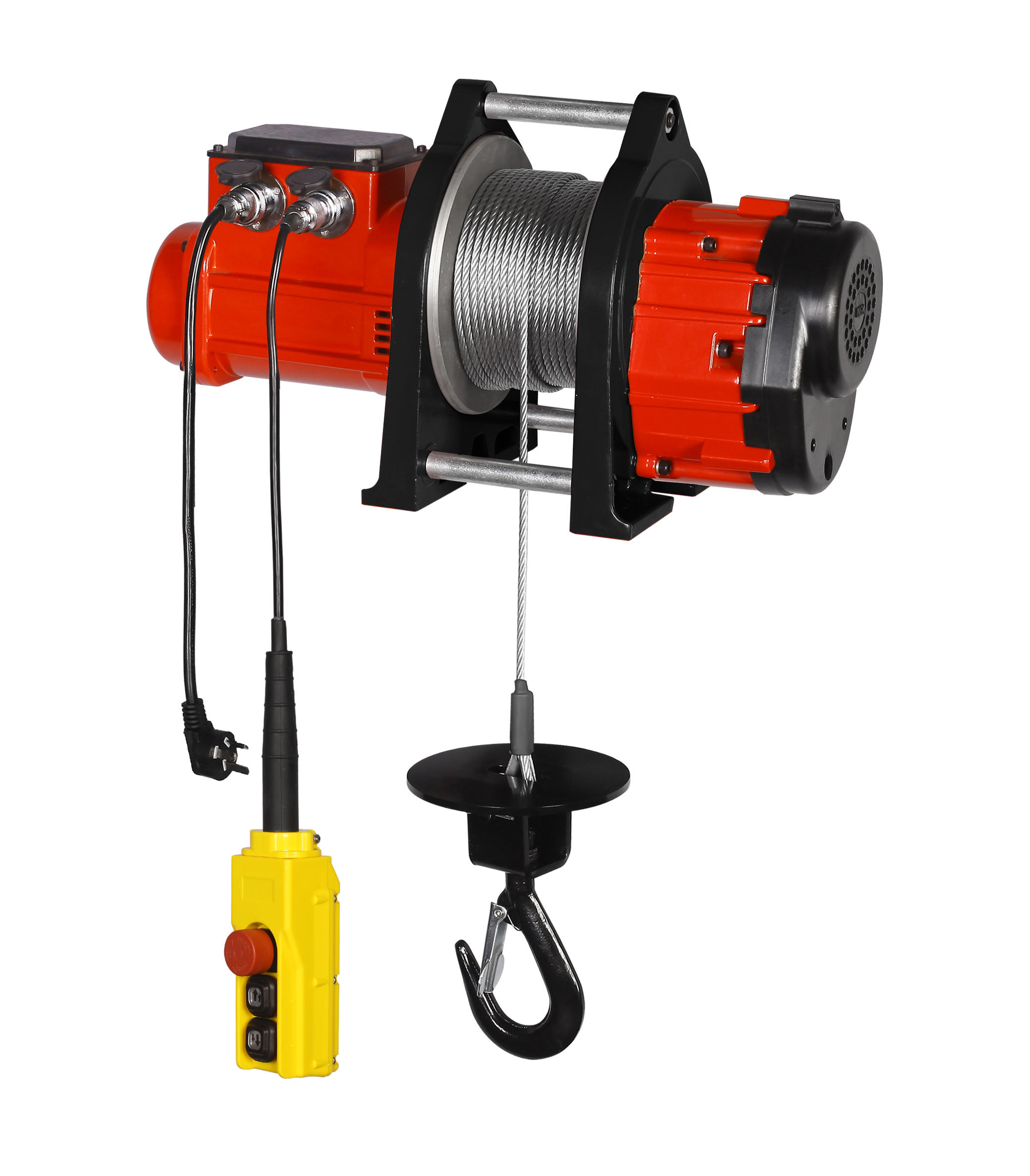
One of the most important distinctions in electric wire rope hoist lifespan is the difference between the life of the hoist as a complete unit and the life of the wire rope that does the actual lifting. These are two separate timelines, and confusing them leads to both safety risks and unnecessary replacement costs.
The wire rope is a consumable component that must be replaced on a cycle far shorter than the hoist's mechanical life. SRP Crane Controls reports that wire rope replacement depends on operational cycles and wear but generally ranges from 1 to 3 years under average use, with visual inspections and expert assessments guiding exact replacement intervals (Source: SRP Crane Controls, The Electric Wire Rope Hoist: A Comprehensive Guide). ISO 4309, the international standard for wire ropes used in cranes, defines discard criteria based on the number of broken wires per lay length, degree of corrosion, reduction in rope diameter, and deformation, providing a quantitative basis for replacement decisions independent of calendar time (Source: H-Lift, FEM vs. ISO Standards for Wire Rope Hoists, referencing ISO 4309).
A patent-based engineering study on wire rope fatigue confirms that the lifespan of a wire rope is evaluated from the cumulative number of repeated bendings until breakage, and that wire rope is typically replaced when it becomes worn to a defined degree rather than when it actually breaks, since the replacement criterion is wear to a threshold rather than failure (Source: USPTO Patent 6339920, Rotation-Resisting Wire Rope). This is the correct and safe approach: replacing wire rope at the discard criterion, not at the point of visible breakage.
What Shortens An Electric Wire Rope Hoist's Life
Several operational and environmental factors consistently reduce the effective working life of an electric wire rope hoist below its design potential, and understanding them allows operators to make targeted interventions rather than general maintenance effort.
Operating Consistently Near Or Above Rated Capacity
Every lift cycle accumulates damage in proportion to the load lifted as a fraction of the rated capacity. Lifting at 90 to 100 percent of rated load every cycle depletes the theoretical SWP hours far faster than lifting at 50 to 60 percent, because the load spectrum weighting in the FEM and ISO classification assumes a statistical mixture of loads across the full capacity range, not continuous maximum-load cycling. Operating a hoist at overload even briefly can cause immediate damage to gears, brake components, and rope drum flanges that is not reversible through maintenance (Source: SHA8-D Wire Rope Hoist Operation Manual, FEM group and load group specifications).
Inadequate Lubrication
KSCRANE's maintenance guidance for wire rope hoists specifies that wire rope should be lubricated every 3 months under normal conditions, and more frequently in heavy use or harsh environments (Source: KSCRANE, Essential Electric Wire Rope Hoist Maintenance and Inspection). Without adequate lubrication, friction between wire strands accelerates fatigue crack initiation at the contact points between individual wires, and corrosion penetrates the rope core where it cannot be seen on surface inspection. Gearbox lubrication is equally critical: insufficient gear oil causes adhesive wear on tooth flanks that progressively reduces gear efficiency and load capacity.
Environmental Contamination
Dust, moisture, corrosive chemicals, and extreme temperature cycles all accelerate the degradation of mechanical, electrical, and rope components. Jenmon's maintenance guidance notes that a dusty or dry hoist does not work effectively and that dust causes electric wire rope hoist components to wear out and shorten lifespan, recommending regular wiping of the wire rope, girder, and all moving parts (Source: Jenmon, Wire Rope Hoist Maintenance Tips for Long-Term Reliability). In outdoor or coastal installations, salt spray corrosion is the primary life-limiting factor for both the rope and the structural components of the hoist frame.
Consumer-Grade Rather Than Industrial-Grade Equipment
Chengdu Weiyuan's product guide is explicit on this point: consumer-grade hoists lacking high FEM or ISO duty ratings are not suitable for industrial production environments, leading to rapid wear, high maintenance costs, and severely reduced lifespan compared to industrial-grade equipment (Source: Chengdu Weiyuan, What Is the Lifespan of an Electric Hoist). The difference between a properly duty-rated industrial wire rope hoist and a commodity equivalent is not only a matter of initial cost but of total cost of ownership across the operating life, since premature replacement, higher maintenance frequency, and unplanned downtime all add cost that the initial price saving does not offset.
Inspection Schedule That Protects Hoist Lifespan
A structured inspection program is the single most effective tool for maximizing the working life of an electric wire rope hoist while maintaining safety compliance. KSCRANE's inspection protocol for wire rope hoists defines three tiers of inspection activity.
- Daily checks before each shift: confirm brake function, limit switches, hook safety latch operation, and the visual condition of the accessible wire rope length for obvious kinks, birdcaging, or broken wires (Source: Chengdu Weiyuan, What Is the Lifespan of an Electric Hoist)
- Periodic checks every 1 to 3 months: inspect the full wire rope length for broken wires per lay length against ISO 4309 discard criteria, measure rope diameter reduction, check wear on sheaves and drum grooves, verify gearbox oil level and condition, and test all electrical controls and limit switches under load (Source: KSCRANE, Essential Electric Wire Rope Hoist Maintenance and Inspection)
- Annual comprehensive safety inspection: full disassembly inspection of brake linings for wear thickness, gear tooth condition check, bearing clearance measurement, motor insulation resistance test, hook throat opening measurement against manufacturer discard limit, and structural inspection of suspension beam and trolley components (Source: KSCRANE)
Jenmon confirms that professional inspection services covering lifting capacity testing, design checking, wire rope inspection, and hoist condition assessment are key to continuous operation and extended service life (Source: Jenmon, Wire Rope Hoist Maintenance Tips for Long-Term Reliability).
Key Components And Their Individual Life Expectations
Within a single electric wire rope hoist, different components reach the end of their service life at different intervals, and understanding this helps maintenance teams plan proactive replacement rather than reactive repair.
- Wire rope: 1 to 3 years under average use, assessed against ISO 4309 broken wire and diameter reduction criteria at each periodic inspection (Source: SRP Crane Controls, The Electric Wire Rope Hoist Guide)
- Brake linings: variable based on braking frequency and load, inspected for minimum thickness at each annual check and replaced before the friction material wears through to the backing plate
- Gearbox: designed to match the hoist's theoretical SWP if correctly lubricated; planetary gearbox arrangements with load distribution across multiple gear sets extend gear life by reducing individual tooth contact stress (Source: Made in China, ISO EN Standard Electric Wire Rope Hoist specifications)
- Motor: electrical insulation degradation is the primary failure mode; thermal protection devices that cut power automatically when motor temperature exceeds limits are a standard protection feature that directly extends motor life (Source: Made in China, ISO EN Standard Electric Wire Rope Hoist specifications)
- Hook: inspected for throat opening increase against a 10 percent discard limit from the original dimension, and for surface cracks by magnetic particle or dye penetrant testing at each annual inspection
How To Maximize The Working Life Of Your Hoist
The gap between a hoist that reaches 10 years and one that reaches 20 or more years is almost entirely determined by the quality of routine care applied over the operating period. The following practices are the most impactful.
- Select the correct duty class from the outset: specifying a hoist with a higher FEM or ISO duty rating than the application requires provides a built-in margin that extends life significantly; the reverse, underspecifying the duty class, is the single fastest way to shorten hoist life (Source: Chengdu Weiyuan, What Is the Lifespan of an Electric Hoist)
- Lubricate the wire rope every 3 months at minimum, cleaning old lubricant and contaminants before applying fresh lubricant to ensure penetration into the rope core rather than only coating the outer surface (Source: KSCRANE, Essential Electric Wire Rope Hoist Maintenance and Inspection)
- Never exceed rated capacity: even a single overload event can cause permanent damage to structural components that maintenance cannot reverse
- Keep the hoist and its environment clean, particularly in dusty fabrication or foundry environments where abrasive contamination of rope and gear surfaces is a primary wear driver
- Replace wire rope proactively at the ISO 4309 discard criterion, not at the point of visible strand failure, since a rope approaching discard has already lost significant safety margin
- Maintain complete service records that track accumulated running hours, enabling comparison against the theoretical SWP hours for the hoist's duty class as the basis for end-of-life planning
The G-Lift Electric Wire Rope Hoist range is designed and duty-rated to support exactly this type of long-service operation, with industrial-grade components, compatibility with structured FEM and ISO inspection programs, and modular designs that enable targeted component replacement to extend overall working life beyond the baseline theoretical SWP.