English
 Español
Content
- 1 What a Chain Hoist Trolley Does on the Runway Beam
- 2 Main Types of Chain Hoist Trolleys and Where Each Fits
- 3 Matching the Trolley to Your Beam and Hoist
- 4 Headroom and Low-Clearance Configurations
- 5 Where Chain Hoist Trolleys Earn Their Keep
- 6 Plain, Geared or Electric: A Side-by-Side Look
- 7 Installation and Safety Checks Before the First Lift
A workshop crew I visited last spring had a perfectly good one ton chain hoist hanging from a fixed point on the runway, and they rolled every load ten meters by hand before the hook could reach it. The problem was not the hoist. The missing piece was a chain hoist trolley, the wheeled carriage that clamps to the beam flange and lets the hoist roll to the work instead of the work rolling to the hoist. The short conclusion of this guide: choose the trolley type by how often and how precisely you must travel, confirm the adjustable side plates span your actual beam flange width, and always keep the trolley rating at or above the hoist rating.
What a Chain Hoist Trolley Does on the Runway Beam
Think of the trolley as the interface between hoist and beam. Two side plates straddle the flange of an I-beam, and threaded suspension pins with spacing washers clamp the plates so the wheels sit squarely on the flange surface. A chain hoist then hangs from the trolley load hook, or a combined unit bolts straight into the trolley clevis, and the fixed lifting point becomes a traveling one. The hoist still does all the vertical work, as explained in our article on how a chain hoist works, while the trolley adds horizontal positioning.
Because every kilogram passes through the trolley wheels into the beam, the runway, its supports and its end stops form one system with the trolley. A rated beam with worn wheels or missing end stops is not a rated system anymore, so treat the parts as a set when you buy and when you inspect.
Main Types of Chain Hoist Trolleys and Where Each Fits
Suppliers generally split the market into three travel types plus a combined variant. The right choice depends less on price tags and more on travel distance, cycle frequency and how precisely the load must be spotted.
Plain Push Trolley
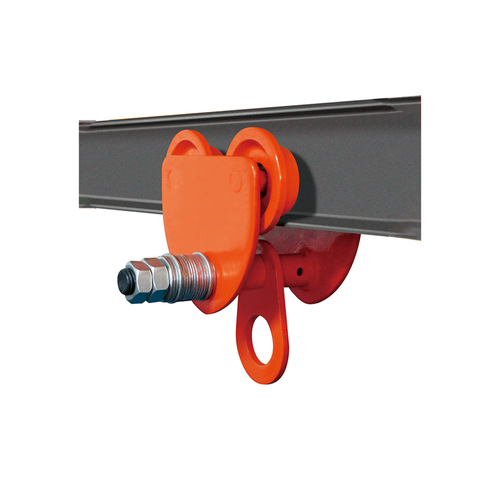
A plain trolley has no drive at all; you push or pull the suspended load by hand. It is the cheapest option and the easiest to install, which makes it common for short bays, light dies and occasional maintenance lifts. Capacity commonly reaches about 10 t, but practical use fades quickly as load weight rises, because the operator must overcome rolling resistance directly and a swinging load is hard to stop precisely.
Geared Trolley
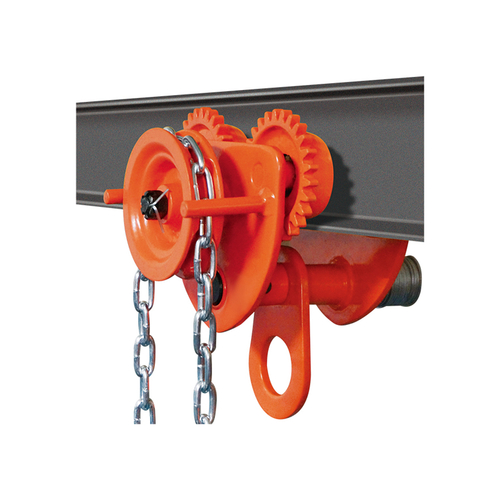
A geared trolley adds a hand chain that drives the wheels through gears. The operator stands clear of the load and pulls a loop of chain, so heavier ratings stay manageable and positioning becomes much finer. Choose this type when loads hang high, when hot or delicate loads must not be touched, or when a load must be spotted within a few centimeters.
Electric Travel Trolley
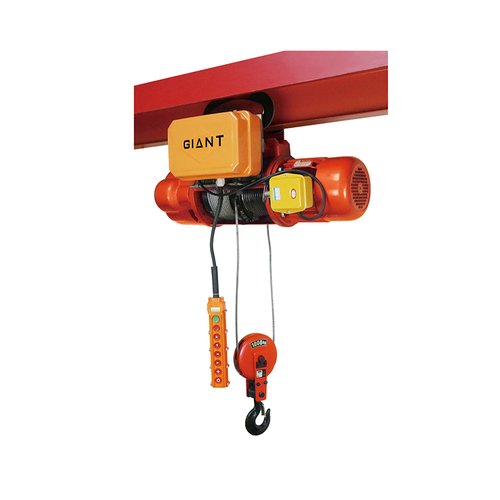
An electric travel trolley motorizes the wheels and pairs naturally with an electric chain hoist on the same pendant or radio remote. It earns its cost on long runways and high cycle counts, such as feeding assembly stations through repeated shifts. Budget for a power supply along the beam and slightly more commissioning work during installation.
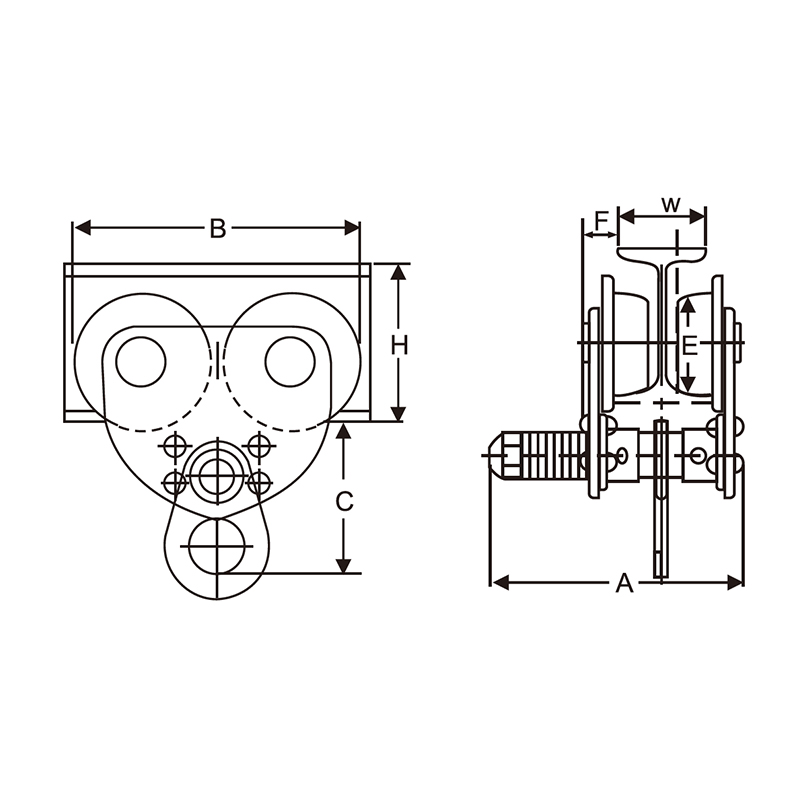 Beam Trolley GCT-E for Powered Travel on I-BeamsThis motorized travel trolley drives along the beam flange and pairs with an electric chain hoist for pendant or radio control. It suits long runways and high cycle counts feeding assembly stations across repeated shifts.View Product →
How to read this chart: the bars show the capacity ceilings that commonly appear in supplier catalogs for each family, so they describe typical availability rather than a rule. Geared trolleys reach the highest ratings because the hand chain multiplies operator force instead of relying on muscle alone. Plain push trolleys usually stop around 10 t, since pushing and stopping that much suspended steel by hand is neither comfortable nor precise. Compact electric travel trolleys commonly cluster near 5 t, while heavier motorized travel mostly lives in engineered crane packages rather than catalog trolleys. Combined low-headroom units generally mirror the plain trolley band because they target tight cells rather than maximum tonnage. Treat every bar as an orientation value and confirm the exact model datasheet before ordering.
Matching the Trolley to Your Beam and Hoist
Three measurements decide fit. Measure the beam flange width across the inside faces at several points, because rolled sections vary along their length, then choose a model whose adjustable range covers that width with margin on both sides. Confirm the trolley rated capacity equals or exceeds the hoist rating, since the trolley also carries the weight of the hoist itself. If your track curves, check the minimum curve radius the manufacturer allows, because wheels and plates designed for straight runways can bind on tight curves.
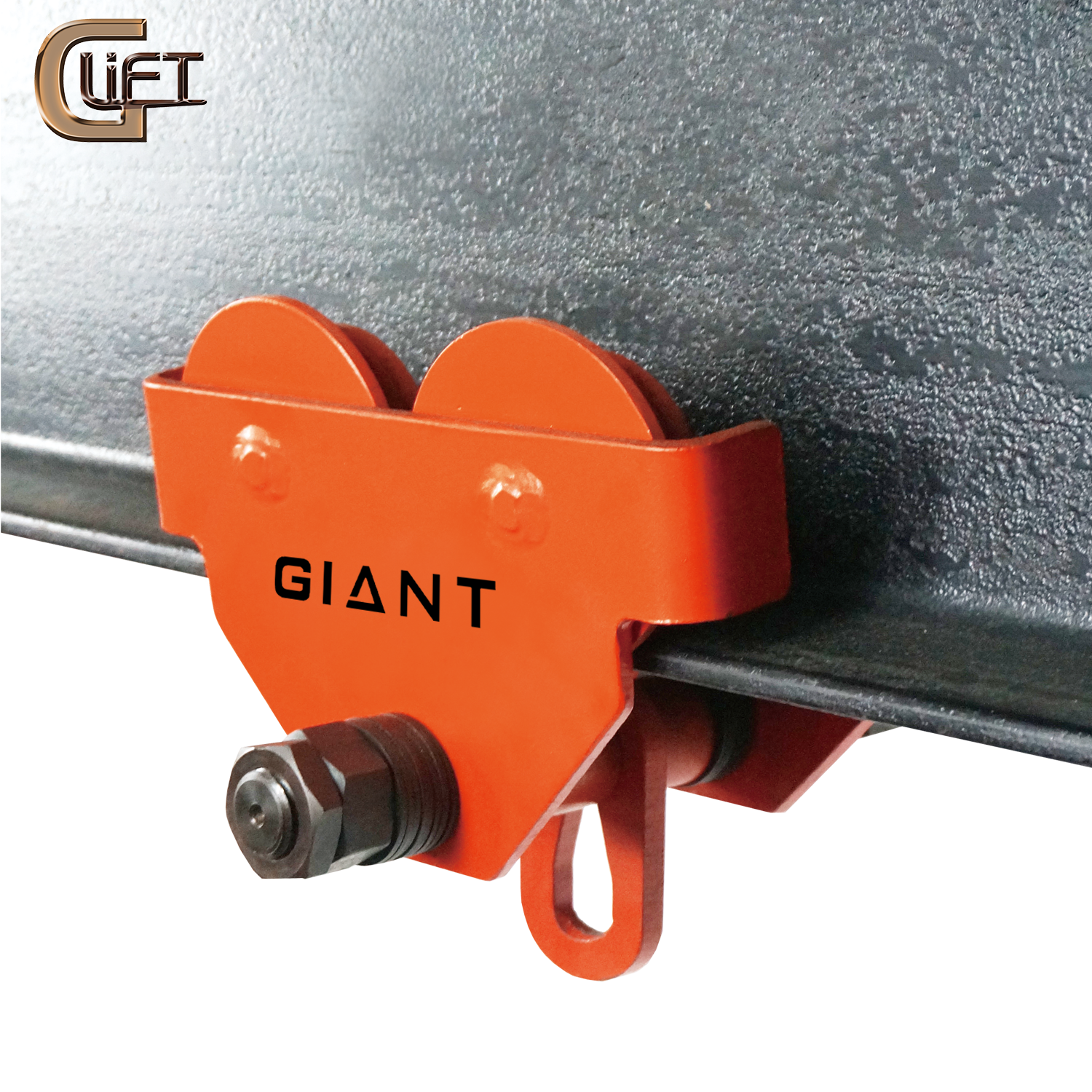 Beam Trolley GCT with Adjustable Beam WidthThis plain push trolley adjusts to any beam flange width by changing the number of collars, with sealed ball bearings and anti-drop plates. Verify flange width, capacity matching the hoist, and minimum curve radius before ordering.View Product →
| Trolley type | Typical capacity range | Typical flange fit | Best suited to |
|---|---|---|---|
| Plain push trolley | 0.5 to 10 t | About 75 to 125 mm, adjustable | Short bays, light loads, occasional moves |
| Geared trolley | 0.5 to 20 t | About 75 to 230 mm, adjustable | Longer travel, heavier loads, precise spotting |
| Electric travel trolley | 0.5 to 10 t | Model specific mounting plates | High cycle counts, long runways, production lines |
| Combined trolley hoist | 0.5 to 10 t | Integrated clamp, fixed range | Low headroom cells and tight conversions |
How to read this chart: each column is the approximate self-weight of a plain or geared trolley at that rating, drawn from typical catalog values. Weight matters more than buyers expect, because someone must lift the unit overhead and hold it while the side plates clamp onto the flange. At the light end this is a two handed job from a step ladder; by 10 t most crews use a second hoist or a lift to seat the trolley safely. Self-weight also adds to what the runway must carry before the payload arrives, which matters on older beams. For export buyers, weight feeds directly into freight cost, so it is worth comparing across shortlisted models.
Headroom and Low-Clearance Configurations
Headroom is the distance from the bottom of the beam to the saddle of the empty bottom hook, and it decides whether your hoist can reach floor level in a building with limited clear height. A hook-suspended hoist on a plain trolley pays that distance twice: once for the trolley saddle and once for the hook, clevis and housing between them. A combined trolley hoist removes the intermediate hook and bolts the hoist body straight into the trolley, which typically returns 60 to 130 mm of useful lift depending on capacity.
 Combined Trolley Hoist CHAG for Low Headroom LiftingBy bolting the hoist body directly into the trolley instead of hanging it on a hook, this combined unit saves roughly 60 to 130 mm of headroom, helping hoists reach floor level in buildings with limited clear height.View Product →
How to read this chart: the two lines trace typical headroom values across common capacities, compiled from representative catalog geometry rather than one specific model. The red line for combined units stays consistently lower, and the absolute gap grows with capacity because hooks and housings scale up with the load chain. At 3 t the saving is roughly 85 mm, which can decide whether a hoist in a 4 m bay reaches the floor with a sling attached. On mezzanines, in pits and inside machine enclosures, that margin often matters more than price. Use the chart to shortlist a configuration, then verify the exact dimension drawings before you commit.
Where Chain Hoist Trolleys Earn Their Keep
In fabrication shops, a trolley keeps one hoist available along the whole welding line, moving plates and welded assemblies between stations. In maintenance bays, it positions motors, pumps and gearboxes over their foundations without forklift access. Warehouses use short runway spines to feed packing and assembly workstations, and construction crews hang temporary runways to set equipment through floor openings. The pattern is always the same: the trolley converts one hoist into a lifting point that covers an area, instead of a point that covers a spot.
Plain, Geared or Electric: A Side-by-Side Look
How to read this chart: six axes score each family from 1, which means weak, to 5, which means strong, and the scores reflect field experience rather than laboratory numbers. Plain push trolleys dominate on purchase economy, installation simplicity and upkeep, which is why they remain the default for light, occasional work. Geared trolleys trade a little of that simplicity for notably better precision and lower operator effort. Electric travel trolleys take speed and precision outright but score lower on economy and installation because of wiring and commissioning. If your crew travels more than roughly ten times per shift, the electric scores start to pay for themselves; below that, geared usually wins.
Installation and Safety Checks Before the First Lift
Most trolley problems trace back to installation shortcuts, so run this sequence on every new runway.
- Inspect the runway beam, its supports and its end stops, and confirm the stops are rated to arrest a trolley moving under load.
- Measure the flange width at several points and set the side plate spacing with the supplied washers so both wheels carry load evenly.
- Seat the trolley on the flange, check that every wheel touches down, and roll it by hand across the full travel before hanging anything.
- Attach the hoist, close the hook latch, and keep the load path vertical during travel and lifting; side pulling is never acceptable.
- Run a light test load across the full travel and watch wheel tracking, brake behavior and hand chain force.
- Put the trolley on the same periodic inspection plan as the hoist, with attention to wheel wear, pin torque and plate alignment.
Local lifting regulations set the formal inspection intervals, and your testing or certification partner can align the plan with them.
A chain hoist trolley is a small fraction of the project budget and a large share of daily usability, so it deserves the same attention as the hoist itself. Decide the travel type first, then lock the flange fit and the headroom numbers, and only then compare prices. Giant Lift manufactures and supplies plain, geared and motorized travel trolleys together with manual and electric chain hoists as matched sets, supported by more than three decades of lifting equipment experience, and the team helps distributors confirm local standard compliance before shipment. You can browse the full lifting and handling catalog to see the complete range.