English
 Español

Content
- 1 What a Chain Ratchet Binder Actually Does
- 2 Ratchet or Lever: Decide by Clearance and Re-Tensioning
- 3 Match Binder Size to Chain Size and Grade
- 4 Hooks Decide Whether the Load Stays Secured
- 5 Working Load Limit, Proof Load, and Marking
- 6 Take-Up Length and Handle Clearance
- 7 Inspection and Retirement Criteria
- 8 Sourcing Notes for Importers and Distributors
Two flatbed drivers called the yard the same morning with the same complaint: the ratchet handle on their new binders bottomed out before the chain came tight, and the load still shifted on the first turn. The binders were not weak. They were the wrong shape for the job. A chain ratchet binder is a tensioning device, not a lifting sling, and it only works when its take-up length, hook style, and working load limit line up with the chain it pulls.
So here is the short version before the detail. Buy the binder by working load limit and chain size first, hook type second, and handle style last. Everything else can be settled with a tape measure and a look at the grade stamp on the chain.
What a Chain Ratchet Binder Actually Does
A ratchet load binder sits between two lengths of chain and pulls them together until the slack is gone. The pawl and gear hold tension while the operator works the handle in short strokes, which is why ratchet binders suit long hauls and heavy loads where a lever binder would need more swing room. Grab hooks at both ends engage the chain, and each stroke shortens the effective length until the load is held firmly against the deck or the side rail.
Two configurations dominate. In direct binding, the binder hooks to the trailer anchor point and the chain runs to the load. In indirect binding, the binder connects chain to chain and the full tension is carried through the chain assembly. The load path differs, and so does the inspection routine, but the buying question stays the same: what rating is marked on the binder, and does it match the chain it will pull?
One rule is not negotiable. Load binders are cargo securement devices and are never rated for overhead lifting. If a customer asks for a binder to lift with, the answer is a chain sling and a hoist, not a heavier binder.
Ratchet or Lever: Decide by Clearance and Re-Tensioning
Lever binders are cheaper, faster to open, and fine for short runs where the driver has room to swing the handle over center. Ratchet binders cost more and take longer to tension, but they allow tension to be added in small increments without releasing the mechanism, which matters when a load settles two hours into a route and has to be checked again at every stop.
Three factors usually settle the choice: handle clearance, how often the load settles, and whether the chain is fixed at both ends. A lever binder needs roughly its handle length in free space, and on a lowboy or inside a curtain-sider that space often does not exist. Ratchet handles move in short arcs. A look at how ratchet load binders differ in design and operation shows that pawl geometry and handle length change the feel of the tool far more than catalog photos suggest.
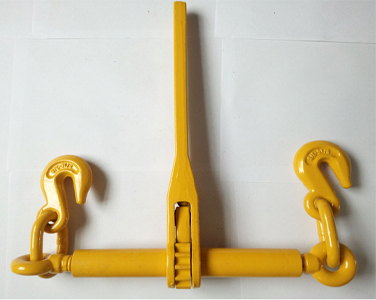 Ratchet Load Binders 140 for Grade 70 and 43 ChainRatchet design reduces kickback risk and short handle arcs suit tight spaces; check WLL against chain before assembly.View Product →
Match Binder Size to Chain Size and Grade
Most mismatches start here. A binder sold for 5/16 inch and 3/8 inch chain is commonly rated around 5,400 lb, while 3/8 inch grade 70 transport chain carries a working load limit of about 6,600 lb. Assemble the two and the binder becomes the lowest rated component in the tiedown, even though everything looks matched on the shelf.
Ratings are published per component, and an assembly's working load limit is governed by the weakest part unless the supplier documents the combination otherwise. Buyers who check chain size only, and never the marked number, ship assemblies that fail a roadside inspection on paper before anything bends.
| Chain size | Grade 70 chain WLL | Grade 80 chain WLL | Typical ratchet binder WLL | Common take-up |
|---|---|---|---|---|
| 1/4 in (7 mm) | 3,150 lb | 3,500 lb | Not commonly offered | Not applicable |
| 5/16 in (8 mm) | 4,700 lb | 4,500 lb | 5,400 lb | 8 in |
| 3/8 in (10 mm) | 6,600 lb | 7,100 lb | 5,400 to 7,100 lb | 8 in |
| 1/2 in (13 mm) | 11,300 lb | 12,000 lb | 9,200 lb | 10 in |
Hooks Decide Whether the Load Stays Secured
Hooks are where field failures and warranty arguments begin. A grab hook throat has to accept the chain link it will pull without letting the link roll out under tension. A hook sized for 5/16 inch chain will not seat a 3/8 inch link properly, and an oversized throat wears the link and the hook together.
Wings are a low cost feature with a real payoff: they stop the chain link sliding sideways out of the throat whenever tension slackens on a rough road. Safety pins lock the link so it cannot jump free while the binder is opened on a slope. For indirect binding, hooks with wings and pins are usually worth the small extra cost.
Slip hooks work the opposite way. The chain slides through the hook and the load is carried on the chain rather than the hook throat. Mixing slip and grab ends on one binder is a common source of assembly confusion, so specify the hook combination deliberately.
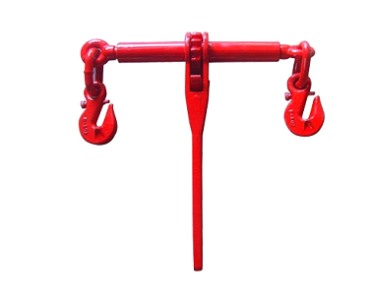 Load Binder with Grab Hooks, Wings, and Safety PinsGrab hook end helps avoid slip-hook assembly confusion; confirm WLL and hook combination for Grade 70 or Grade 43 chain.View Product →
Working Load Limit, Proof Load, and Marking
Three numbers matter. The working load limit is the maximum tension the binder should see in service. The proof load is normally twice that figure and is applied as a one time verification test. Ultimate or breaking strength is typically four times the working load limit, giving the 4:1 design factor common to cargo securement hardware.
Insist that the rating is forged, stamped, or tagged in a way that survives the finish. A binder with a painted over or sticker only rating is hard to defend at inspection and impossible to trace if a batch is questioned. For export orders, confirm how the destination market expects ratings to be declared, since rules such as 49 CFR 393 in the United States and EN 12195-3 in Europe treat lashing chains and their tensioning devices in specific ways.
Take-Up Length and Handle Clearance
A binder has a usable range, not an infinite one. Eight inches of take-up means the assembly can be shortened by roughly eight inches between fully open and fully closed. Cut the chain too long and the handle bottoms out with the load still loose. Cut it too short and the binder cannot be hooked up at all.
The working method: hook the binder, run the chain to the anchor point, and adjust so about one third of the take-up remains when the load is tight. That leaves room to re-tension after the load settles without releasing everything.
Handle style follows the truck. Longer handles give more leverage but need a wider arc, while folding handles store flat and suit tighter European trailer layouts. A standard lever binder remains the fastest tool on short hauls, provided the driver genuinely has the swing clearance on both sides of the load.
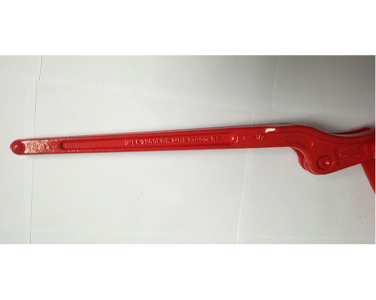 Standard Load Binders 150 for Chain TensioningStandard lever design offers fast chain tightening on short hauls when swing clearance allows; match its WLL to Grade 70 or 43 chain.View Product →
Inspection and Retirement Criteria
Binders are retired for wear, not for age. A workable routine covers:
- Handle condition, including bends, twists, or a handle that no longer locks at the end of its travel.
- Ratchet and pawl, looking for rounded teeth, a pawl that skips a tooth, or any release under tension.
- Chain, checking for stretched or elongated links that no longer sit flat against a gauge.
- Hooks, checking throat opening growth beyond roughly 15 percent of the original, cracks at the shank, and bent or missing safety pins.
- Load bearing parts, where any welding, heating, straightening, or repair means the binder comes out of service.
One habit saves more equipment than any inspection: tension by hand only. A cheater bar on a binder handle can push tension past the working load limit and overload the chain, the anchor point, and the trailer deck at once.
Sourcing Notes for Importers and Distributors
The gap between a reliable binder and a problematic batch is rarely visible in a sample photo. What matters is consistency: the same hook throat opening shipment after shipment, the same handle length, the same marking method, and a hook that actually fits the chain sold alongside it.
Worth writing into a purchase order: working load limit and proof load, chain size compatibility, hook type and whether wings and safety pins are fitted, finish such as galvanized or powder coated, handle style, and packaging with clear use and inspection instructions in the destination language. Batch markings and proof test records make claims handling far simpler than arguing over an unmarked pallet.
Hangzhou Giant Lift supplies this category alongside the rest of the assembly, so buyers often combine load binders with grade 70 and grade 80 chain, grab and slip hooks, shackles, turnbuckles, and ratchet tension pullers on one order. That matters because the assembly is what gets inspected, not the individual parts. A supplier able to review chain, hook, and binder together against a destination market's requirements removes a step most importers otherwise handle with sample by sample checking. In house product development and quality control teams also support customized handle lengths, finishes, and private label packaging, which is where much of the value in this product line sits.
Chain ratchet binders are simple tools with a short list of things that must line up: chain size, marked working load limit, hook type, take-up length, and handle clearance. Get those five right and the roadside check, the re-tension at the first stop, and the second year of service take care of themselves. Get them wrong, and no upgrade in chain grade will compensate.