English
 Español

Content
- 1 What Counts as a Cantilever Crane
- 2 The Main Cantilever Configurations
- 3 The Specifications That Decide the Purchase
- 4 Matching a Cantilever Crane to the Workstation
- 5 Installation and Upkeep: Where Most Problems Start
- 6 When a Cantilever Crane Is the Wrong Choice
- 7 Buying a Cantilever Crane for Import and Distribution
A 480 kg pump housing has to come off a machining centre, be turned for deburring, and go back onto the fixture. The nearest overhead crane is 7 m away, and the operator has 40 seconds before the next cycle. That is the job a cantilever crane is built for.
A cantilever crane carries its load on a boom supported at one end only, so there is no bridge beam across the building and no second leg standing in the aisle. The conclusion first: it is the fastest lifting tool you can put over a single workstation, and the one most often mis-sized, because the two numbers that matter most, capacity at full reach and boom deflection, are rarely the first numbers a buyer checks.
What Counts as a Cantilever Crane
The defining feature is simple. A boom is anchored at one end and free at the other. A pillar jib, a wall mounted jib, an articulating jib, a mobile shop crane and a single leg cantilever gantry all share the same load path: the turning moment from the load travels back into a mast, a bracket or a counterweight.
That is why the specification conversation differs from a bridge crane. On an overhead crane the span between the rails usually controls the design. On a cantilever crane, reach controls it. Rated capacity normally holds at the shortest hook position and falls as the hook travels outward, and that single fact causes more returns than any other in this product family. If your job is lift at one bench all day, a cantilever crane is cheaper and quicker. If it is lift anywhere in a 20 m bay, it is the wrong machine.
For applied examples of how these designs behave in commercial and industrial settings, see this overview of cantilever crane applications.
The Main Cantilever Configurations
Cantilever lifting equipment sold into workshops and yards falls into five practical groups.
- Pillar mounted jib. Stands on a base plate or foundation and usually slews 360 degrees. The base sees a large overturning moment rather than a simple compressive load, so the foundation has to be designed for it.
- Wall or column mounted jib. Bolts to a structural wall or building column and normally slews 180 or 270 degrees. Cheaper, and it keeps the floor clear, but the host structure must be verified for the moment and the local forces.
- Articulating jib. Two boom sections with a knuckle between them, so the hook can reach behind a machine or around a column. More joints mean more maintenance points.
- Mobile cantilever arms. Workshop and engine cranes with a boom on a wheeled base, either counterweighted or built on a folding leg frame. The crane travels to the job instead of the job travelling to the crane.
- Cantilever gantry. A single leg with a long overhang, used where the load must be picked from outside the rail track, common with precast panels and long steel sections.
Mobile versions do most of the work in maintenance bays and small workshops, which is why they are offered across a wide spread of capacities and boom geometries.
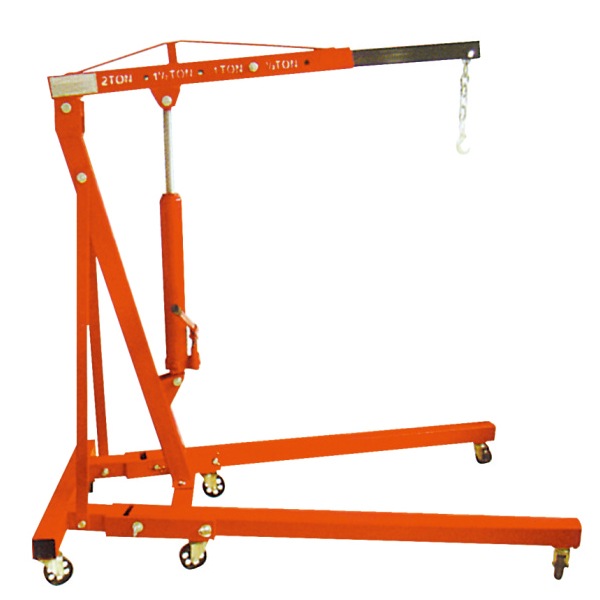 Standard Shop Crane-TL Folding Hydraulic Shop CraneIt comes in 1–2 ton models with a four-hole reinforced boom and 550–2000 kg capacities, suited to maintenance bays and small workshops.View Product →
The Specifications That Decide the Purchase
Five numbers settle most cantilever crane questions. Ask for all of them in writing, quoted at the reach you will actually use.
| Specification | Typical range | Why it matters |
|---|---|---|
| Rated capacity | 125 kg to 5,000 kg | Must include the hoist, hook block, slings and spreader, not only the payload |
| Reach or boom length | 1 m to 8 m for jibs | Defines the covered circle, and capacity falls as reach increases |
| Hook height and headroom | 2 m to 6 m under the boom | Sets the tallest item you can lift and clear over a machine |
| Slew angle | 180, 270 or 360 degrees | Depends on the mounting type and the end stops that are fitted |
| Boom deflection | 1 in 150 to 1 in 200 of boom length | Affects positioning feel and shows how much stiffness you are buying |
| Duty classification | Light to heavy workshop duty | High cycle counts need a higher class, not just a larger motor |
Deflection deserves a note. A boom that flexes noticeably under load is not automatically unsafe, but it makes precise placement harder. Confirm that the quoted figure is at rated load and full reach, and check whether it covers the boom alone or the whole structure including the mast.
Matching a Cantilever Crane to the Workstation
Walk the job before reading a catalogue. The sequence below catches the mistakes that are expensive to reverse.
- Measure the real load, including fixtures, slings and trapped fluid, then add 20 percent for future parts.
- Mark the pick point and every landing point. The covered circle is drawn from the mounting point, not from the machine.
- Check headroom above the boom and clearance below it. A low boom costs more usable height than a short hoist.
- Verify the host structure. A wall bracket and a floor plate impose completely different loads on a building.
- Choose the hoist separately. Chain hoists suit fast, frequent, moderate loads; wire rope hoists suit higher lifts and longer duty.
- Count the lifts per shift. Twenty lifts and two hundred lifts are two different products.
- Agree the compliance route for the destination market before the order, not after arrival.
Where space is tight
Low headroom and narrow aisles push the choice toward a counterbalanced mobile arm, which uses weight at the back of the base to hold the moment instead of a large floor footprint. The trade off is that the counterweight occupies aisle space while the crane travels, so measure the aisle with the crane in mind, not only the load.
 Counterbalance Shop Crane-JLPH Manual Foldable Shop CraneA counterbalanced manual shop crane with 600/500/400/300 kg ratings and 530 kg net weight, useful where low headroom and narrow aisles rule out bigger footprints.View Product →
Installation and Upkeep: Where Most Problems Start
Most cantilever crane problems reported in workshops trace back to the mounting rather than to the boom.
- Base plate and anchor bolts. Bolt grade, embedment depth, hole pattern and grouting all matter, and the reaction loads supplied by the manufacturer have to reach the structural engineer in writing.
- Level and alignment. A pillar that is out of plumb loads the slewing bearing unevenly and shortens its service life.
- Cable management. A crane slewing a full 360 degrees needs a festoon, a conductor bar or a slip ring arrangement that does not twist the supply cable.
Before first use, the crane should be load tested and the result recorded. Practice varies by market, but a static test above rated capacity followed by a dynamic test at rated capacity is the usual pattern, and the certificate is what an inspector asks for later.
In service, check the hook latch, the chain or rope, the brake, the controls and the end stops before each shift. Re torque the mast and bracket bolts, grease the slewing bearing and lubricate the hoist monthly. Arrange a third party inspection annually, covering welds, structural deflection, brake wear and electrical insulation. Stop work immediately if the boom shows permanent set or the slewing motion becomes stiff or noisy, because both get worse quickly under load.
When a Cantilever Crane Is the Wrong Choice
Cantilever cranes are excellent at one narrow job and poor at everything else. Three signals point to a different machine. The load has to be set down at points far apart in the same bay. The lifting area is outdoors, or on ground where a foundation is impractical. One crane has to serve several workstations, where a travelling structure usually costs less per lift than three separate jibs.
For yard work, maintenance bays and temporary sites, a movable gantry crane covers many of the same jobs without any foundation at all, because it carries the load between its own legs and can be repositioned as the work moves.
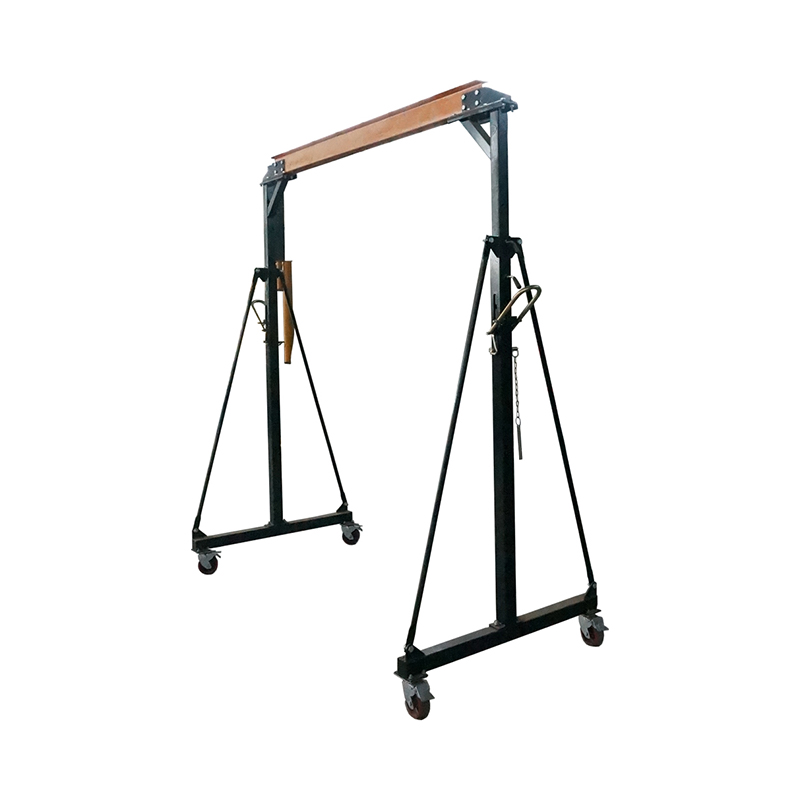 Movable Gantry Crane for Portable Workshop LiftingA portable four-piece gantry with 1000 kg and 2000 kg models, adjustable height, and no foundation, suited to yards, maintenance bays, and temporary sites.View Product →
Buying a Cantilever Crane for Import and Distribution
If you are sourcing rather than using, three items separate a clean order from a difficult one.
First, agree the rating basis. Confirm whether capacity is gross, meaning it includes the hoist and the lifting attachment, and whether it holds at full reach. Importers who assume the wrong basis end up handling warranty claims from end users.
Second, ask for documentation with the shipment: a load test certificate, material certificates for the boom and mast, welding records, a paint specification and a maintenance manual in the destination language. That package is what lets a distributor sell into a market with inspection requirements instead of holding stock that cannot be installed.
Third, plan spares alongside the crane order. Slewing bearings, hoist chains, brake assemblies, pendants and anchor bolt sets have long lead times and short selling seasons. Decide early whether the crane ships as a stand alone unit or bundled with hoist, trolley and slings, because complete packages generate far fewer installation complaints.
The quick test before you buy: draw the circle the boom will cover, mark every point the load must reach, and confirm that the capacity at the far edge of that circle still clears the load with margin. If it does, a cantilever crane will outperform almost anything else at that workstation. Sourcing the boom, the hoist and the rigging as one documented package from a single supplier, as Giant Lift does across its lifting and material handling range, keeps the paperwork and the spare parts list in one place.