English
 Español
Content
- 1 What Counts as a Battery Powered Hoist
- 2 Duty Cycle, Speed and the Numbers Buyers Skip
- 3 Specifications and Tolerances to Check on the Datasheet
- 4 Where Battery Powered Hoists Earn Their Keep
- 5 Battery Management, Charging and Cold Weather
- 6 Safety, Standards and Compliance Before You Order
- 7 How to Match a Model to the Job
- 8 Sourcing Notes for Distributors and OEM Buyers
A maintenance crew has to lift a 300 kg pump housing out of a plant aisle where the nearest three phase socket sits 40 metres away. Running cable, hiring a generator and getting a temporary supply signed off takes longer than the lift itself. This is the job a battery powered hoist was built for.
The short answer first: battery powered hoists and winches suit intermittent lifts, generally up to about 1 tonne, on sites where mains power is missing, awkward or expensive to bring in. They are a poor fit for a production line that lifts every two minutes for eight hours. Buy on lifting capacity alone, without checking duty cycle, battery voltage and brake design, and the unit will either fade partway up or wear out its battery pack inside a year.
What Counts as a Battery Powered Hoist
Four formats are sold under this name, and they behave very differently on the job, so it pays to separate them before comparing prices.
- Battery chain hoist with an integrated pack. A lithium pack of 18 V, 20 V or 48 V sits in the housing, and the load is controlled by pendant or wireless remote. Capacity usually runs from 250 kg to 1 t.
- Battery powered winch. A DC motor of 12 V, 24 V or 48 V drives a drum and wire rope. These units are built for pulling and dragging as much as for vertical lifting, and a 2 t horizontal pull rating is common.
- Drill powered chain hoist. A mechanical chain hoist driven by a standard cordless drill. Capacity is normally 250 kg to 500 kg, and the appeal is that the crew already owns the power source.
- Mini electric hoist with a battery pack. Lighter units of 100 kg to 300 kg, often used for lifting panels, tooling and components rather than structural loads.
| Format | Typical capacity | Power source | Duty cycle | Typical use |
|---|---|---|---|---|
| Integrated battery chain hoist | 250 kg to 1 t | 18 V to 48 V lithium pack | 15 to 25 percent | Plant maintenance, rigging, temporary installs |
| Battery powered winch | 500 kg to 2 t pull | 12 V to 48 V DC | 10 to 20 percent | Pulling, recovery, off grid sites |
| Drill powered chain hoist | 250 kg to 500 kg | Cordless drill battery | 10 to 20 percent | Events, stage work, service calls |
| Mini electric hoist with pack | 100 kg to 300 kg | 12 V to 24 V | 10 to 20 percent | Workshops, panels, light components |
If the job is a pulling job rather than a straight vertical lift, a compact battery winch such as the SQL05 series covers short runs without any mains connection at all. It is light enough for one person to carry and hook up.
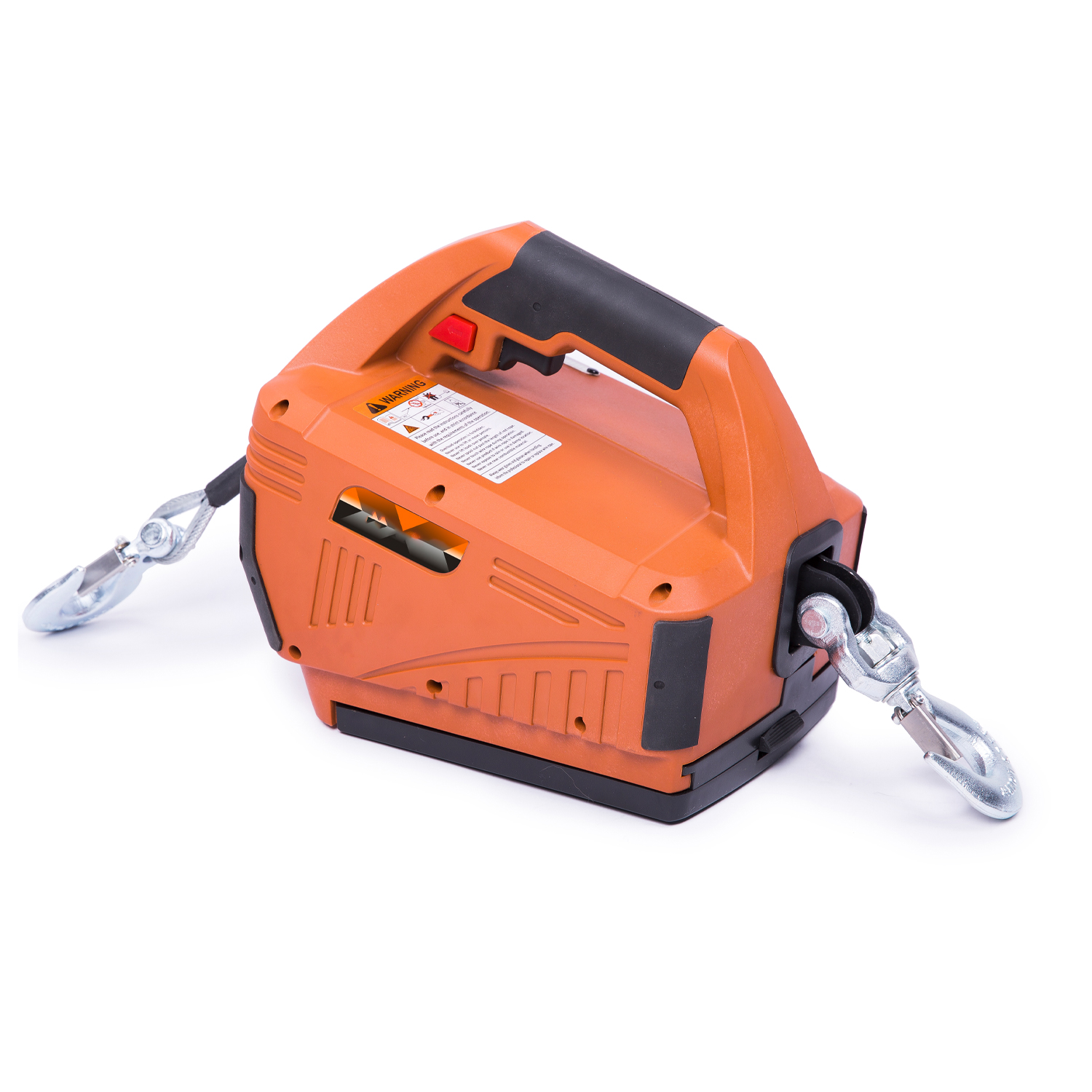 SQL05 Battery Powered Mini Electric WinchFor pulling jobs without mains power, this 1000 lb battery winch is light enough for one person to carry and hook up.View Product →
Duty Cycle, Speed and the Numbers Buyers Skip
A 20 percent duty cycle means two minutes of running in every ten, and that is the figure that decides whether a battery hoist survives the job. A mains powered chain hoist on the same beam often runs a 40 to 60 percent duty cycle, which is why swapping one for the other without checking is a common and expensive mistake.
- Lifting speed. Battery models commonly lift at 1 to 3 m per minute, while mains chain hoists manage 4 to 8 m per minute. A 6 m lift can therefore take three minutes instead of one.
- Lifts per charge. A 5.0 Ah 18 V pack may deliver 40 to 80 short lifts under part load, and noticeably fewer at rated capacity or in cold weather.
- Lifting height. This is limited by chain length or by the rope capacity of the drum, not by the motor.
- Derating. Continuous operation near the rated load at 40 C ambient will trigger thermal protection on most designs, so treat the headline capacity as a peak figure.
Specifications and Tolerances to Check on the Datasheet
- Proof load. Ask for the test certificate rather than the advertised figure. Static proof testing is usually 125 percent of rated capacity, dynamic testing around 110 percent.
- Load chain. G80 or G100 alloy chain with the grade marked on the link, galvanized for damp environments or black oxide for dry indoor use.
- Brake type. A mechanical load brake or an electromagnetic brake that holds the load when power is cut. A hoist that drifts after the button is released should not leave the supplier.
- Hook condition. Forged hooks with a safety latch. A hook opening stretched beyond roughly 10 percent of its original dimension is a reject, not a repair.
- Ingress protection. IP54 as a minimum for outdoor work, IP65 for washdown or dusty yards.
- Control voltage. Low voltage pendant control of 24 V or 48 V is preferable to mains voltage at the handle.
- Remote range. Wireless models typically pair over 10 to 30 m, and a fixed pairing ID prevents one remote from operating a neighbouring hoist.
- Temperature range. Most units are rated from minus 10 C to plus 40 C, and lithium packs lose usable capacity below freezing.
Where Battery Powered Hoists Earn Their Keep
The economics work when the lift is occasional and the cost of bringing power to the load is high. Typical applications include:
- Shutdown and maintenance work in pump rooms, tunnels and basements where temporary supplies are restricted.
- Rental fleets, exhibition builds and stage rigging, where crews arrive with cordless tool kits and no distribution board.
- Remote sites, telecom towers and transmission line work far from any socket.
- Docks, yards and vehicle recovery, where a pulling winch with its own battery beats waiting for a tow truck.
- Service vans and mobile workshops that need lifting capability on arrival.
For event and rigging crews, a drill powered chain hoist is often the most practical answer because the drill and its packs are already in the flight case and no separate charger has to be carried.
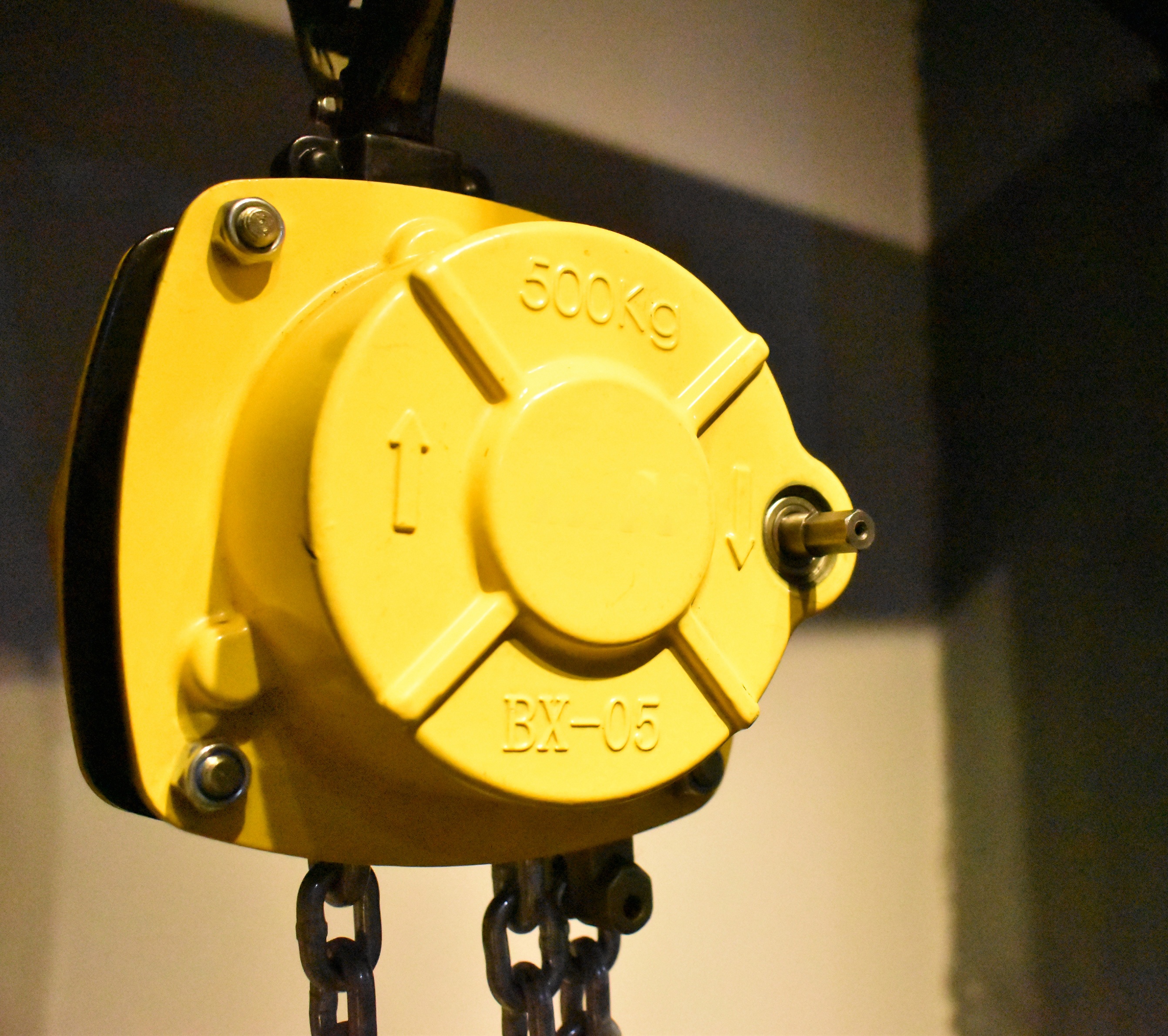 HSH-D Drill Powered Chain HoistFor crews already carrying drills, this chain hoist uses alloy steel hooks that deform under overload and a sealed, corrosion-resistant brake.View Product →
Battery Management, Charging and Cold Weather
Lithium packs fail early for two reasons: deep discharge and heat. A well specified unit includes a battery management system with a low voltage cut off, so the hoist stops lifting before the pack is damaged, plus built in protection against excessive battery discharge during long pulls. Practical rules that extend pack life:
- Buy a second pack. A spare doubles usable duty cycle for a fraction of the cost of a larger hoist.
- Charge between 0 C and 40 C, and never charge a frozen pack straight off a truck in winter.
- Store packs at roughly half charge for long periods instead of leaving them full in a hot container.
- Check charger input voltage for the destination market, since 110 V and 230 V versions are separate part numbers.
Safety, Standards and Compliance Before You Order
For importers and distributors, paperwork is part of the product. A battery hoist for a regulated market should arrive with a load test certificate, a declaration of conformity and a manual in the local language. Relevant reference points include ASME B30.16 for overhead hoists, ASME B30.7 for drum winches and EN 14492-2 for power driven hoists, alongside an ISO 9001 factory system. Lithium packs and cells need UN38.3 test reports and a safety data sheet before they can be shipped by sea or air.
Two failure modes are worth writing into your inspection checklist. First, overload protection that is absent or set far above the rated capacity. Second, no means of controlled lowering if the battery dies mid lift, which turns a small problem into a suspended load that nobody can bring down safely. Daily checks should cover the brake, the hook latch and the chain, and a load chain is normally taken out of service once elongation reaches roughly 1.5 to 2 percent over a measured section.
How to Match a Model to the Job
- Add up the real load, including slings, shackles and the spreader, then add a 20 percent margin.
- Count the lifts per shift and the height of each one. That gives you the duty cycle and the chain or rope length you actually need.
- Decide on the power platform. Standardising on the packs your crew already uses saves money and avoids a shelf of orphan chargers.
- Confirm the mounting method: hook, beam trolley, beam clamp, gantry or crane.
- Check the environment for rain, dust, salt air and temperature extremes, then match the IP rating.
- Request the certificate, spare parts list and a replacement battery price before placing the order.
When the lift is heavier or the pull is longer, a battery powered electric winch with an integrated pack takes over from the mini units, and it still runs without any site power at all.
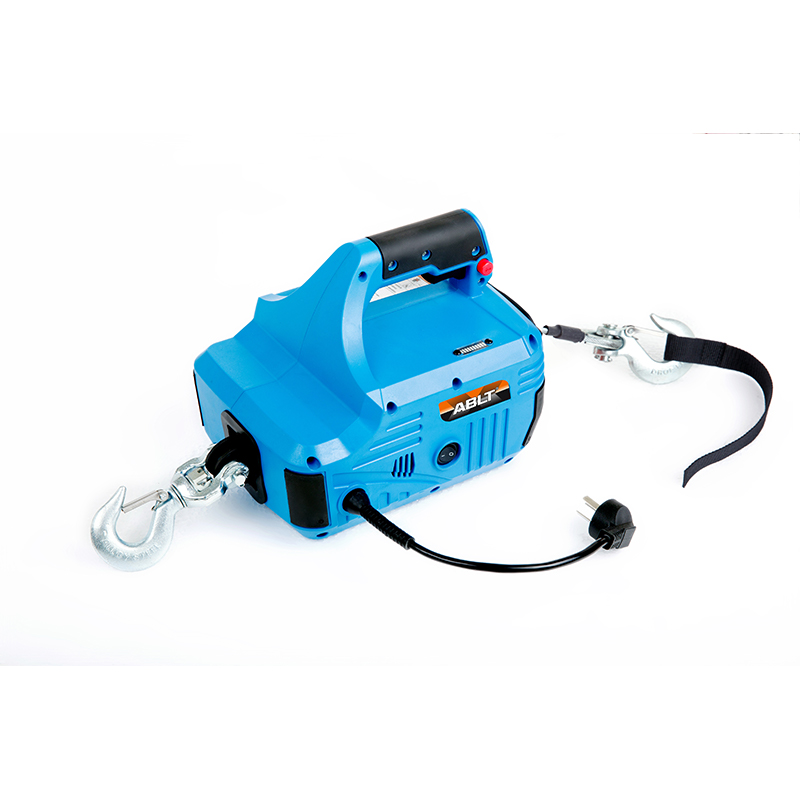 SLQ-B Battery Powered Electric WinchFor heavier lifts or longer pulls without site power, this battery winch offers 1000 lb capacity and an integrated 24 V Ni-MH battery pack.View Product →
Sourcing Notes for Distributors and OEM Buyers
Battery powered hoists are rarely bought alone. They sit in a catalogue next to hand pallet trucks, stackers, jacks and rigging hardware, and a single supplier that can consolidate those lines saves a container and a set of shipping documents. Ask for the full electric chain hoist range alongside the battery models when you build a mixed order, and confirm whether the manufacturer can customise voltage, plug type, labelling and packaging for your market.
Giant Lift, based in Hangzhou, has supplied lifting and material handling equipment to more than 50 countries and covers chain hoists, winches, trolleys, jacks and rigging accessories under one roof. Practical questions to put on the table are minimum order quantity, spare battery and controller availability, warranty terms, and whether the supplier will help review a product against your local standards before it ships.
Battery powered hoists solve a real and specific problem: lifting and pulling where a cable cannot reasonably go. They are not a universal replacement for mains powered equipment, and the buyers who get the best results are the ones who match duty cycle, speed and battery platform to the actual job instead of comparing capacity figures in isolation. Get those three right, keep a spare pack charged, and the hoist will still be working when the generator would have been packed away.