English
 Español
Content
Two workers clip their lanyards onto the same M12 eyebolt on a warehouse roof. The bolt carries no marking and no paperwork. Whether it holds or tears out decides whether the fall arrest system works.
The short answer: a fall protection anchor point must support at least 5,000 pounds, or 22.2 kN, for every worker attached to it, or be engineered and certified as part of a complete personal fall arrest system with a safety factor of at least two. It must also be independent of any anchorage used to support or suspend a platform. A harness and a lanyard only transmit force. The anchor point absorbs it.
Most fall arrest failures begin at the anchorage rather than at the harness. What follows covers the numbers behind that requirement, the anchor types found on site, how to build a temporary point correctly, and the checks worth running before you order.
The 5,000 Pound Rule and Where It Comes From
OSHA sets the baseline in the United States. Under 29 CFR 1926.502(d)(15) for construction and 1910.140(c)(13) for general industry, an anchorage used for personal fall arrest equipment must be capable of supporting at least 5,000 pounds per employee attached, or be designed, installed and used as part of a complete system under the supervision of a qualified person, with a safety factor of at least two. OSHA's interpretation letter of 8 February 2011 adds a second condition: anchorages for personal fall arrest equipment must be independent of any anchorage used to support or suspend platforms.
That is a per-person figure. Two workers sharing one point need 10,000 pounds unless the point belongs to an engineered system with a documented design.
Static and dynamic loads are different things. A worker of 100 kilograms in a free fall, stopped by a lanyard that limits arrest force to 4 kN, still pushes a transient load into the anchor well above the static figure, because the force path passes through the anchorage first. An arrest-force limit protects the user's body. It does not lower the requirement placed on the anchor point.
Lifting hardware is not fall protection hardware. A forged eyebolt with a working load limit of 500 kilograms is designed for a known direction and a dead mass. Fall arrest involves a person, movement and an unpredictable direction of pull. Unless an item is certified to a fall protection standard and marked as such, it does not become an anchor point because it looks strong.
Anchor Point Types and How They Behave
Anchor points fall into a few practical families. Two distinctions run through all of them. First, certified devices that arrive with marking, instructions and a stated user limit, against structural members assessed by a competent person. Second, single-user points against multi-user systems, which carry roughly double the strength requirement.
| Anchor type | Where it is used | How strength is established | What to check |
|---|---|---|---|
| Permanent structural anchor | Steel column, roof beam, cast-in insert | Documented design or competent person assessment, 5,000 lb per worker | Corrosion, undocumented field welding, missing marking |
| Certified anchor device | Roof, wall, ladder, parapet | Type tested to EN 795 or ANSI Z359.1 | Correct class for the application, user limit, instructions |
| Beam clamp or trolley anchor | I-beam, monorail, wide-flange column | Manufacturer's rated load | Flange thickness and width, tightening torque, load direction |
| Sling or choker around a member | Column, beam, pipe rack | Member and sling both rated, with reduced capacity for the hitch | Sharp edges, heat, chemical damage, ultraviolet exposure |
| Horizontal lifeline | Long-span roofs, loading bays | Engineered system, several times the load of a single point | Sag and tension, end anchor strength, number of users |
| Deadweight or freestanding anchor | Membrane roofs, temporary work | Manufacturer's rating, usually one user | Tipping when the line goes taut, certification, surface condition |
| Anchor post or davit | Parapets, ladders, manholes | Type tested, fixed or portable | Base condition, bolt torque, installation depth |
The table is a starting point for a risk assessment, not a substitute for one. A beam clamp rated at 5,000 pounds on a flange inside its stated range is a different object from the same clamp tightened onto a flange half the required thickness.
Standards to Match Against the Destination Market
- United States: OSHA 29 CFR 1910.140 and 1926 Subpart M, supported by ANSI/ASSP Z359.1 for personal fall arrest systems, Z359.6 for engineered systems and Z359.11 for full body harnesses.
- Europe: EN 795 for anchor devices, with types A to E covering structural anchors, transportable anchors, horizontal lifelines and deadweight anchors, alongside EN 361 for harnesses and EN 355 for energy absorbers.
- Canada: CSA Z259.16 for the design of active fall protection systems, with CSA Z259.10 for harnesses.
- Marking on the product: standard number, manufacturer, model, batch or serial number, date of manufacture and maximum number of users.
The standard quoted on the anchor tells you which market the item can be sold into. A supplier who can produce a test report for the exact model named in the order, rather than for a product family, removes most of that certification risk.
Building a Temporary Anchor Point on Site
Beam clamps on steel
A beam clamp rated for fall protection and matched to the flange thickness is a common temporary point on an I-beam or wide-flange column. Check three details. The flange width and thickness must fall inside the clamp's stated range, the tightening torque must follow the manual, and the point should sit vertically above the work position so a fall is arrested before the lanyard crosses an edge.
 Beam Clamp-LJ-Q for Fall-Protection Anchor PointsProduct page presents Beam Clamp-LJ-Q; nearby fall-protection guidance highlights checking flange fit, torque, and vertical positioning.View Product →
Choker slings around structural members
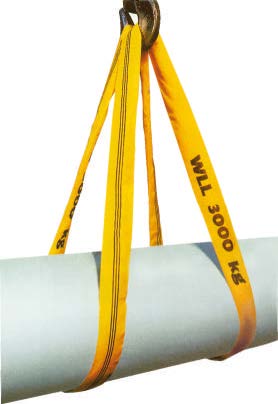
A polyester round sling in a choker hitch is widely accepted as a temporary anchor around a column, beam or pipe rack when a competent person confirms the member is strong enough and the sling is protected from sharp edges. The choke reduces capacity, so a sling rated at 5,000 pounds in a vertical hitch may deliver around 4,000 pounds in a choker. Work from the reduced figure. Retire any sling with cuts, glazing or chemical damage, and remember that polyester round slings handle heat and abrasion differently from wire rope.
 Round Sling-R7-04 Polyester Round Sling with Wear-Resistant SleevePolyester round sling with a two-ply woven sleeve, DIN-EN1492-2 colour coding, capacity stripes, printed SWL, and CE declaration; useful near choker-hitch capacity guidance.View Product →
Horizontal lifelines and wire rope terminations
Long spans usually call for a horizontal lifeline rather than a single anchor. These are engineered systems: span, sag, end anchor strength and the number of users are calculated together, and the end anchors typically resist several times the load of a single point because of the tension built into the line. Terminations at each end must use hardware sized for the rope diameter, and tension has to be set to the figure in the design, not to what feels tight.
.jpg) Aluminum Alloy Wire Rope Grip SL-CGL SeriesAluminum alloy wire rope grip with SL-CGL1 to SL-CGL5 models, listed cable ranges, rated loads, grip sizes, and weights; relevant to tension-puller and anchor-register checks.View Product →
Aluminum Alloy Wire Rope Grip SL-CGL SeriesAluminum alloy wire rope grip with SL-CGL1 to SL-CGL5 models, listed cable ranges, rated loads, grip sizes, and weights; relevant to tension-puller and anchor-register checks.View Product →Installation, Inspection and the Failures That Recur
- Loading direction. A fall over an edge changes the angle of pull and can reduce capacity below the rating stamped on the anchor.
- Pendulum effect. An anchor placed in line with the work position prevents a swing into a lower structure or a wall.
- Corrosion and deformation. A bent shank, a cracked weld or visible section loss is a retirement, not a repair.
- Shared anchorage. Points used for fall arrest must stay separate from points that support or suspend a platform.
- Records. Pre-use checks by the user, plus periodic inspection by a competent person at intervals set by the manufacturer and local rules.
Most incidents traced back to an anchor involve an item that was never rated for the job, installed in the wrong direction, or missing from the inspection log for years. A register listing location, model, rated load, installation date and last inspection date covers most of that gap.
What to Check Before You Order
Four questions sort a supply base quickly. Which standard does this exact model hold, and can you send the test report and certificate for it? What is marked on the product itself? Is the anchor part of a matched system that includes harness, lanyard and connectors, so the weakest link is known? Can the supplier review the item against the standard required in your market before shipment?
For an importer buying across categories, consolidation matters almost as much as the certificate. Hangzhou Giant Lift Co., Ltd., which trades as Giant Lift, manufactures and sources lifting, material handling, hydraulic and construction tools, and states that it can check products against local market standards before shipment. That suits a distributor who wants anchors, slings, wire rope grips and harnesses on one order with matching documentation instead of four suppliers and four sets of paperwork.
Anchor points for fall protection follow a short set of rules. Five thousand pounds per worker, or an engineered system supervised by a qualified person with a safety factor of two. Independent of platform supports. Marked, documented and inspected. The anchor is usually the cheapest part of a fall arrest system, and it is where the system most often fails. Match the standard to the market you sell into, keep certificates for the exact model, and treat an unmarked eyebolt as what it is: a lifting point, not a fall protection anchor.