English
 Español
Content
The core difference is design and load orientation: a flatbed cart sits low to the ground on four wheels and carries loads horizontally, while a hand truck stands upright on two wheels and tilts loads backward to move them vertically balanced. Flatbed carts excel at transporting wide, heavy, or multiple items across flat surfaces, whereas hand trucks are better suited for stacked boxes, appliances, and tall loads that can be tipped and rolled. Choosing the right tool depends on the shape of your load, your working environment, and how far you need to move things.
Side-by-Side Comparison at a Glance
| Feature | Flatbed Cart | Hand Truck |
|---|---|---|
| Wheel configuration | Four wheels | Two wheels + toe plate |
| Load orientation | Horizontal (flat) | Vertical (tilted back) |
| Typical load capacity | 500–3,000+ lbs | 150–1,000 lbs |
| Best load type | Wide, flat, or multiple items | Boxes, barrels, appliances |
| Stairs / curbs | Not suitable | Yes (stair-climbing models) |
| Operator effort | Push / pull horizontally | Tilt and roll |
| Storage footprint | Large (flat platform) | Small (leans against wall) |
| Typical price range | $60–$400+ | $30–$200+ |
What Is a Flatbed Cart?
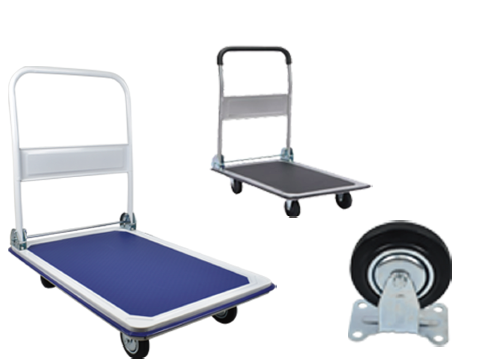
A flatbed cart — also called a platform cart or utility cart — consists of a flat, rigid deck mounted on four swivel or fixed wheels. The load sits directly on the deck in its natural horizontal position and is pushed or pulled by the operator without tilting. This makes flatbed carts ideal when the item cannot or should not be tipped, such as large glass panels, machinery, potted plants, or palletized goods.
Flatbed carts typically range from compact models with a 24 × 36 inch deck up to large industrial platforms exceeding 30 × 60 inches. Load capacities span from around 500 lbs for light warehouse carts to 3,000 lbs or more for heavy-duty steel-frame industrial models. Because all four wheels share the load, the cart remains stable even when fully loaded, requiring minimal physical effort from the operator on flat surfaces.
Common Flatbed Cart Applications
- Moving multiple boxes or packages in a single trip across a warehouse floor
- Transporting large, awkward items such as lumber, sheet metal, or furniture
- Retail and home improvement store use for customer self-service loading
- Moving fragile equipment or electronics that must remain upright and level
- Industrial and manufacturing floor logistics where loads exceed hand truck capacity
What Is a Hand Truck?
A hand truck — also called a dolly or sack truck — is an L-shaped frame with two large wheels at the base and a small toe plate (nose plate) that slides under the load. The operator tips the hand truck backward so the load balances over the axle, then rolls it on just two wheels. This lever-like design transfers much of the load's weight through the axle rather than the operator's arms, making it far easier to move heavy items over short distances.
Standard hand trucks have a load capacity of 150–500 lbs, while heavy-duty models can handle up to 800–1,000 lbs. The vertical frame height typically ranges from 40 to 57 inches, accommodating loads of varying heights. Because hand trucks store upright and lean flat against a wall, they occupy very little floor space — a significant advantage in crowded workspaces.
Common Hand Truck Applications
- Moving stacked cardboard boxes during delivery, moving, or warehousing
- Transporting appliances such as refrigerators, washing machines, and dryers
- Moving kegs, water jugs, or barrels in food service and catering
- Navigating stairs with stair-climbing or tri-wheel hand truck models
- Delivery operations where operators frequently load and unload from vehicles
Key Structural Differences Explained
Wheel Count and Stability
The four-wheel layout of a flatbed cart distributes weight evenly across a wide base, providing excellent stability even for heavy or top-heavy loads. No operator effort is needed to keep the load balanced — it simply sits on the platform. A hand truck's two-wheel design requires the operator to tilt and balance the load over the axle, which demands more skill but allows the cart to pivot tightly and maneuver in narrow spaces.
Load Size and Shape Compatibility
Flatbed carts accommodate virtually any load shape — wide, oddly shaped, or irregularly sized items that cannot be balanced vertically. Hand trucks are best suited for items that are taller than they are wide (boxes, cylinders, appliances) and have a flat bottom edge that the toe plate can engage securely. Attempting to use a hand truck with a load wider than the frame creates an unstable and unsafe condition.
Maneuverability in Tight Spaces
A hand truck's narrow two-wheel profile allows it to fit through standard doorways, navigate tight hallways, and turn in very confined spaces. Flatbed carts — particularly larger models — require more clearance to turn and can be difficult to maneuver in congested areas. A typical hand truck is only 18–22 inches wide, while a standard flatbed cart platform may be 24–36 inches wide, creating meaningful differences in where each tool can be used.
This is one of the most decisive differences. Hand trucks — especially stair-climbing models with tri-wheel or star-wheel configurations — can ascend and descend stairs. Flatbed carts cannot navigate stairs at all; they require ramps or level transitions between surfaces. For delivery professionals or movers who regularly encounter stairs, a hand truck is the only practical choice.
Load Capacity: How Much Can Each Handle?
Both tools cover a wide range of capacities depending on their construction, but flatbed carts generally support higher maximum loads due to their four-point weight distribution.
| Model Type | Capacity Range | Frame Material |
|---|---|---|
| Light-duty flatbed cart | 500–800 lbs | Plastic or light steel |
| Medium-duty flatbed cart | 800–1,500 lbs | Steel |
| Heavy-duty flatbed cart | 1,500–3,000+ lbs | Heavy-gauge steel |
| Standard hand truck | 150–400 lbs | Aluminum or steel |
| Heavy-duty hand truck | 400–1,000 lbs | Steel |
| Convertible hand truck | 300–800 lbs | Steel |
Special Variants Worth Knowing
Convertible Hand Trucks
A convertible hand truck can switch between two-wheel upright mode and a four-wheel horizontal platform mode by folding out additional wheels. This gives users some of the functionality of both tools in a single device. However, the platform size in cart mode is typically small — around 14 × 18 inches — which limits its usefulness for large or wide loads compared to a dedicated flatbed cart.
Stair-Climbing Hand Trucks
Stair-climbing hand trucks feature a tri-wheel or star-wheel cluster at each side instead of a single large wheel. When encountering a step, the rotating cluster rolls one wheel at a time over the edge, allowing the operator to ascend or descend stairs with a loaded hand truck. These models are especially valuable for appliance delivery, moving companies, and any application involving multi-floor buildings without elevator access.
Fold-Flat Flatbed Carts
Some flatbed carts feature a folding handle and collapsible frame that allows the cart to be stored flat when not in use, reducing the storage footprint significantly. These models are popular in retail, hospitality, and home use where storage space is limited but a full platform capacity is still required.
Which One Should You Choose?
Use this decision guide to match the right tool to your situation:
- Choose a flatbed cart when your load is wide, flat, heavy, or cannot be tipped — such as machinery, stacked pallets, lumber, or fragile equipment. Also prefer a flatbed cart when moving multiple items at once across a flat surface.
- Choose a hand truck when your load is tall, box-shaped, or cylindrical and can be safely tipped. Hand trucks are the right choice when stairs are involved, when working in narrow spaces, or when you need a compact tool that stores easily.
- Choose a convertible hand truck if you need both capabilities occasionally and space or budget prevents owning two separate tools, accepting the trade-off of a smaller platform and lower capacity in cart mode.
In professional environments such as warehouses, moving companies, or delivery services, having both tools available is the most practical solution — each handles a range of tasks the other cannot, and together they cover virtually any manual material handling need.