English
 Español
Content
The Critical Role of Material Grade in Wire Rope Performance
Selecting the appropriate Wire Rope is a decision that impacts the safety, longevity, and cost-efficiency of industrial operations. A Wire Rope is not merely a single piece of metal but a complex mechanical system of strands and wires that must work in harmony under tension. In the modern lifting and rigging industry, the environment determines the material; using the wrong specification can lead to premature failure or unnecessary expenditure.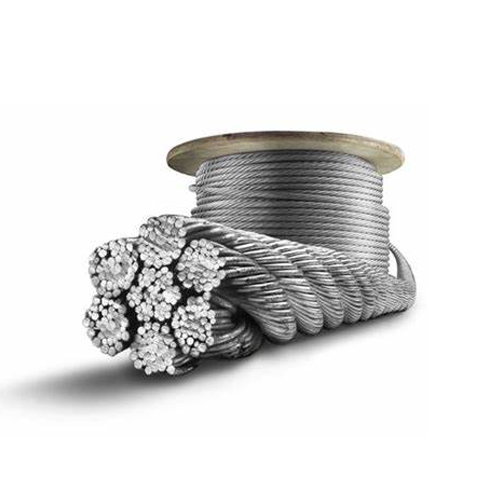
Whether you are operating in a dry warehouse or a high-salinity maritime environment, understanding the metallurgical differences between your options is essential. The two primary choices for most heavy-duty applications involve either Galvanized Wire Rope or Stainless Steel Wire Rope. Each has distinct advantages that cater to specific load requirements and atmospheric conditions.
Technical Analysis: Galvanized vs. Stainless Steel Wire Rope
The choice between materials often comes down to the trade-off between absolute corrosion resistance and initial purchase price. Galvanized Wire Rope features a zinc coating that provides a sacrificial layer of protection against moisture and rust. Conversely, Stainless Steel Wire Rope is an alloy that offers uniform resistance throughout the entire diameter of the cable.
| Feature | Galvanized Wire Rope | Stainless Steel Wire Rope |
|---|---|---|
| Corrosion Resistance | Moderate (Zinc Layer) | Highest (Inherent Alloy) |
| Tensile Strength | High Efficiency | Slightly Lower |
| Cost Per Meter | Economical | Premium Investment |
| Primary Application | Construction & General Towing | Marine & Chemical Plants |
Structural Engineering of the Wire Rope Strands
Strand Configuration and Flexibility
Beyond the material, the "lay" and configuration of the Wire Rope define how it behaves under load. A common configuration like 7x19 (seven strands with nineteen wires each) offers excellent flexibility, allowing the Wire Rope to bend over pulleys without fracturing. For static applications, such as guy wires or structural bracing, a stiffer 1x19 construction may be preferred due to its higher breaking strength and lower stretch characteristics.
The Importance of the Core
Every Wire Rope features a central core that supports the outer strands. A fiber core provides greater elasticity and lubrication storage, while an Independent Wire Rope Core (IWRC) provides maximum resistance to crushing and is essential for multi-layer spooling on winch drums. Choosing an IWRC ensures that the Wire Rope maintains its shape even under the most punishing industrial pressures.
Practical Maintenance for Heavy-Duty Wire Rope
The lifespan of a Wire Rope can be significantly extended through proactive field maintenance. Even galvanized versions require attention to prevent the zinc layer from wearing away at friction points. Implementation of the following steps can increase service life by up to 40%:
- Consistent lubrication with acid-free grease to reduce internal wire-on-wire friction.
- Avoidance of "shock loading," which can permanently deform the Wire Rope core.
- Monthly inspections for "nicks" or "kinks" that signal a localized loss of integrity.
Frequently Asked Questions (FAQ)
What is the main difference between galvanized and steel Wire Rope?
Technically, both are made of steel. However, Galvanized Wire Rope is dipped in zinc for surface protection, whereas standard steel (often called "Bright") has no coating and relies entirely on external lubrication for rust prevention.
Can I use Stainless Steel Wire Rope for all lifting tasks?
While Stainless Steel Wire Rope is excellent for corrosion resistance, it is generally slightly more brittle than galvanized steel. It should be used when rust is the primary concern, but for pure weight-lifting capacity in dry conditions, galvanized is often more effective.
When should a Wire Rope be immediately replaced?
A Wire Rope must be retired if you observe more than 10% reduction in nominal diameter, any heat discoloration, or if the number of broken wires exceeds safety limits set by OSHA or local regulatory bodies.