English
 Español
Content
A fabrication shop receives a new order for steel staircases. The first task is to lift a 2-tonne plate off the stack, turn it from vertical to horizontal, and feed it into the cutting table. The rigger chooses a lifting clamp instead of a sling, because a clamp grips the plate directly and lets the crane move it with a single attachment point. Lifting clamps are below-the-hook devices that grip steel, concrete, or timber by friction or cam pressure, and they must match the load, the material thickness, and the orientation of the lift. The wrong clamp creates a serious drop hazard, so understanding the basic types, capacity ratings, and inspection rules matters before any purchase. This guide explains how lifting clamps work, which type fits which job, and how to select one safely.
What Is a Lifting Clamp?
A lifting clamp attaches a steel plate, beam, or pipe directly to a crane, hoist, or chain block without the need for slings, shackles, or manual strapping. The clamp body is made from forged or cast steel, and the gripping jaw contains hardened teeth or a serrated pad that bites into the material. The key principle is self-locking: as the load increases, the pivot geometry presses the cam or lever harder into the material, so the grip becomes stronger under tension. This is what makes clamps faster and safer than friction devices that depend on manual tightening. Standard clamps are designed to international norms such as ASME B30.20 and EN 13155, and every clamp carries a working load limit (WLL) stamped into its body.
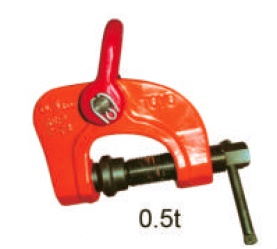 STC Lifting Clamp for Steel PlatesThis forged-steel lifting clamp offers a self-locking grip for steel plates in workshop lifting tasks. Its stamped WLL and jaw opening markings help operators verify suitability before each lift, making it a practical choice for routine fabrication and structural work.View Product →
For most steel fabrication and structural work, the TC series of lifting clamps and plate clamps covers the common range of plate thicknesses and load weights seen in a typical workshop. The visible WLL marking, jaw opening, and orientation symbol on the clamp body should always be checked before any lift.
Types of Lifting Clamps
Clamps are classified by the orientation of the load during the lift, the shape of the material, and the geometry of the jaw. Choosing the correct type is the first step; only then can you think about capacity.
Vertical lifting clamps
Vertical plate clamps are designed for plates that hang with their thickness in the vertical plane, for example a plate standing on edge or being turned from flat to vertical. The jaw opens from the side, and the teeth grip the two faces of the plate. They are the most common clamps in steel service centers because they allow a crane to pick, flip, and stack plates without any worker touching the load.
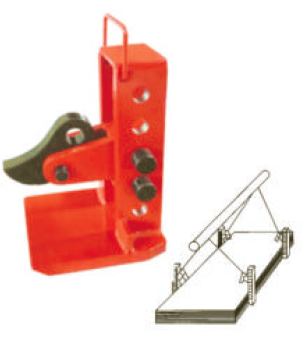 PDK Multi-Steel Plate Clamp for Vertical LiftsDesigned for plates hanging in a vertical plane, this clamp grips both faces with hardened teeth, enabling safe picking, flipping, and stacking without worker contact. It suits common steel service center operations where plate thickness must be matched precisely.View Product →
Horizontal lifting clamps
Horizontal plate clamps lift plates that lie flat, with the jaw gripping the top and bottom faces. They are widely used when a plate must stay horizontal, for example when feeding a plasma cutting table or loading a stack of blanks onto a truck. The grip is applied from above and below, so the clamp must be sized to the actual plate thickness with little room for error.
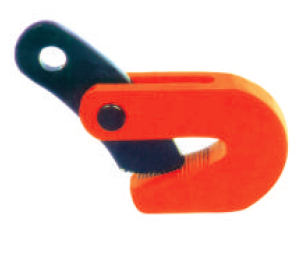 DHQL Horizontal Clamp for Lying PlatesThis horizontal plate clamp grips the top and bottom faces of flat plates, ideal for feeding cutting tables or loading blanks. It must be sized accurately to plate thickness, ensuring secure horizontal lifts during material handling and stacking tasks.View Product →
Beam clamps
Beam clamps attach to the flange of an I-beam, H-beam, or channel rather than to a flat plate. They are used to suspend a hoist or chain block from an overhead beam, or to lift a beam itself during structural assembly. The jaw wraps around the flange and locks with a screw or cam. Beam clamps tend to have the highest capacity range among clamp types because structural flanges are thick and stiff.
Specialty clamps
Beyond plates and beams, there are clamps for concrete pipes, plywood panels, rolled steel coils, and timber. Concrete pipe clamps grip the wall thickness of precast pipes and culverts; plywood clamps grip the edge of panels without crushing the wood; roll steel clamps handle coils and strips. These specialty tools solve rigging problems that slings cannot handle safely, but they must be matched to the exact material and dimensions.
| Clamp Type | Lift Orientation | Typical WLL | Jaw Range | Common Jobs |
|---|---|---|---|---|
| Vertical plate clamp | Plate standing with edge vertical | 0.5 - 5 t | 0 - 40 mm | Plate turning, stacking, crane pickup |
| Horizontal plate clamp | Plate lying flat | 1 - 3 t | 10 - 30 mm | Feeding shear lines, loading plate bundles |
| Beam clamp | Attached to beam flange | 0.5 - 10 t | 5 - 40 mm flange | Hoist suspension, beam lifting |
| Universal clamp | Multi-angle with rotating shackle | 1 - 5 t | 0 - 30 mm | Repositioning, angled lifts |
| Concrete pipe clamp | Around pipe wall | 1 - 6 t | 20 - 60 mm | Precast pipe and culvert handling |
The chart shows the typical working load limit ranges across five clamp categories used in industry. Vertical plate clamps cover half a tonne to five tonnes, which matches the plate weights handled in steel fabrication and structural workshops. Beam clamps have the widest span because they grip a stiff flange and can support loads up to ten tonnes, making them a popular choice for suspending hoists. Horizontal clamps carry lower capacities because a flat plate offers a shallower gripping surface and the load acts directly against the jaw. Concrete pipe clamps sit in the middle, reflecting the wall thickness and weight of standard precast pipes. Always compare the stamped WLL on the clamp body with the actual weight of the load before lifting.
How to Choose a Lifting Clamp
Select a clamp in three steps: decide the orientation of the load, measure the material thickness, then confirm the working load limit. These three checks eliminate most mismatched purchases.
Start with the hanging orientation
If the plate will be vertical when lifted, use a vertical clamp; if it stays flat, use a horizontal clamp. A vertical clamp used on a flat lying plate can slip, because the teeth are not aligned with the direction of the load. Universal clamps with a rotating shackle accept a limited range of angles, but each model has angle limits that must not be exceeded. For a broader view of how lifting tools fit into a production line, see our material handling equipment selection guide, which covers load types, movement paths, and the interaction between tools.
Match the jaw to the plate thickness
Measure the actual material thickness with a caliper. The jaw opening of the clamp must be equal to or larger than that thickness, but not so large that the teeth contact only a small area. Most manufacturers publish a thickness range, and the rated load is valid only inside that range.
The line chart shows how the working load limit of a typical vertical plate clamp changes as plate thickness moves through its jaw range. A clamp rated for plates from 0 to 30 mm reaches full capacity around 15 mm, where the cam geometry produces the strongest grip. Near the top of the jaw range, the teeth engage less material and the contact area shrinks, so the safe load must be reduced. At very thin material, the plate can deform before the clamp develops its designed grip, which explains the lower rating at the bottom of the range. Many manufacturers publish derating tables for both ends of the thickness range. Running a clamp at full rated load outside its optimal thickness window increases the risk of slipping or dropping the load.
Check the working load limit
The WLL is the maximum load the clamp can carry in its intended orientation under normal conditions. It is stamped on the body and appears in the datasheet. Multiply the real weight of the load by an impact factor, typically 1.25 for crane motion, and confirm that the figure stays below the WLL. Do not use a clamp whose WLL is lower than the load just because the jaw fits.
Account for surface condition and hardness
Heavy rust, mill scale, paint, grease, and moisture all reduce gripping friction. Clean the contact area before each lift. The hardness of the material also matters: hardened steel can dull the clamp teeth, while very soft aluminium can be crushed by excessive force. For unusual materials, ask the manufacturer for testing data or choose a clamp with interchangeable pads.
Understand the angle limits
Some clamps are rated for straight vertical lifts only, while other universal models allow a rotation angle of 45 to 90 degrees. Side loading is a common cause of clamp failure because it applies bending stress to the jaw and pin. If the lift involves turning or repositioning, use a clamp specifically rated for that angle and reduce the load according to the derating chart. When in doubt, keep the lift straight.
Where Clamps Are the Wrong Tool
Lifting clamps are not a universal replacement for slings and spreader beams. They are risky for loads with irregular shapes, thin walls, soft materials, or surfaces that change during the lift. Drums, crates, and palletised goods should be handled with pallet forks, drum clamps, or slings rather than jaw clamps. A clamp also cannot be used if the plate has punched holes, cut-outs, or sharp edges exactly where the teeth must grip. Understanding these limits prevents a rigger from reaching for a clamp when a different tool is safer.
The column chart shows the relative share of lifting operations in which clamps are used across six industrial sectors. Steel fabrication has the highest adoption because nearly every cutting, drilling, and welding operation involves positioning steel plates that are dangerous to handle by hand. Shipbuilding ranks second, with plate clamps used to move hull sections and deck plates across the yard. Construction sites use clamps for structural steel erection and precast elements, but slings and chains remain common for general lifting. Precast concrete handling relies heavily on purpose-designed pipe and plate clamps, although the total number of operations is smaller than in steel fabrication. Warehouse and workshop operations use clamps least, because most loads there are packaged, palletised, or handled by forks rather than by crane. This pattern shows that lifting clamps are a specialised rigging tool, not a universal substitute for slings.
Safety Rules and Common Mistakes
Most lifting clamp accidents come from a small set of repeated mistakes. The first is using a vertical clamp for a horizontal lift; the teeth are oriented for the wrong load direction and can release mid-lift. The second mistake is exceeding the WLL, often by estimating the load weight instead of checking the plate label or calculating the weight from dimensions. A third risk is side loading, which bends the jaw pin and can cause fatigue fractures. There is also a minimum load on most clamps: a very light plate may not produce enough force to keep the cam engaged. Operators should only use a clamp on material within the stated thickness range and for the orientations marked on the body. Before each lift, check that the clamp locks correctly and the spring returns the handle to the closed position. If this guide seems long, remember this one rule: if the load can slip, it will slip, so confirm the clamp type, thickness, and WLL in that order. Routine problems such as worn teeth, broken springs, and stuck hinges are common in workshops that use clamps daily. Our overview of common lifting product issues and how to solve them is a useful reference when a clamp starts behaving differently from when it was new.
Inspection and Maintenance
A lifting clamp is a safety device, and like a chain or a hook, it has to be inspected before every use and serviced on a schedule. The operator check takes about 30 seconds: look for cracked welds, bent frames, worn or chipped teeth, loose hinge pins, and a free moving spring. The WLL marking and orientation symbol must still be legible. Once a year, or more often under heavy use, a clamp should be stripped down, cleaned, and inspected by a competent person. Pay particular attention to the condition of the spring, because a broken spring leaves the jaw half open and prevents the clamp from latching onto the plate. If teeth are worn to less than half their original height, replace the jaw pad or the whole clamp. Repairs should use original manufacturer spare parts, because non-genuine springs and pins are a frequent cause of premature failure. Keep a log for each clamp with dates of inspection, any repairs, and the person who carried them out.
How Do You Decide?
When several clamp models can fit the same plate, compare them by the criteria that matter for your specific operation. The radar chart below compares vertical, horizontal, and beam clamps on five factors: load capacity, safety margin, ease of positioning, versatility, and value for cost. The scores are a general benchmark, not a replacement for the datasheet of a specific model, but they help you see the trade-off pattern quickly.
The radar chart shows a clear pattern across the three main clamp families. Vertical clamps score well on capacity, safety, and ease of use, but their narrow versatility makes them the right choice only for plate lifting in the vertical plane. Horizontal clamps are easier to position on stacked plates but carry lower capacity, which keeps them suited to light and medium fabrication work. Beam clamps stand out for capacity and versatility because they attach to a structural flange and can support hoists, trolleys, or loads from many angles. Their weaker point is value for cost, since the heavier body and wider jaw raise the unit price. For a mixed workload, a set of vertical clamps supported by a couple of beam clamps usually gives the best coverage. Start with the load orientation, then let the price follow the function.
Final checklist before buying
- Confirm the lift orientation: vertical, horizontal, or multi-angle.
- Measure the material thickness and compare it with the jaw opening range.
- Calculate the true load weight and add a safety factor; keep it below the WLL stamped on the clamp.
- Check the surface condition: remove rust, scale, oil, or paint from the gripping area.
- Decide whether the clamp needs a spring loaded lock, a rotating shackle, or interchangeable pads.
- Plan the inspection routine and keep spare parts from the original manufacturer.
- Store clamps in a clean, dry place and protect the teeth from impact damage.
Choose a lifting clamp the same way you choose a chain or a hook, based on the load, the environment, and the maintenance plan. A clamp that matches the plate thickness and stays below its rated limit will serve for years, while a mismatched clamp can fail without warning. If your workload changes, revisit the thickness and angle limits rather than assuming one clamp covers everything. Suppliers who specialise in lifting equipment can help you match a TC series clamp or a plate clamp to your exact job, but the final responsibility for a safe lift always stays with the operator.