English
 Español

Content
- 1 The Main Crane Attachment Families
- 2 Hooks, Shackles and the Connection Chain
- 3 Lifting Clamps for Plate and Structural Steel
- 4 Beam Clamps, Trolleys and Overhead Attachment
- 5 Slings, Sling Angles and Rated Capacity
- 6 Crane Scales and Load Verification
- 7 Matching Attachments to the Hoist and the Load
- 8 Inspection, Marking and Records
- 9 Specifying Crane Attachments Before You Order
A 2 t chain hoist and a 2 t load are not automatically a safe pair. If a two-leg sling sits at 30 degrees from horizontal, each leg already carries 1 t, and the part most likely to fail is not the hoist but the attachment. Crane attachments set the real working limit of a lift, and they do it part by part: the hook, the shackle, the clamp, the sling and the scale each have their own rated capacity and their own inspection rules. What follows explains the main attachment families, where capacity gets lost through angles and surface conditions, and what to verify before you approve a lift or place an order.
The Main Crane Attachment Families
Below-the-hook equipment is easier to manage when it is grouped by job rather than by shape. There are four jobs: connecting the load to the hoist, gripping the load, holding the load, and monitoring the load. Most lifting incidents come from a mismatch inside one of those groups, such as a clamp chosen for the wrong plate thickness or a sling used at an angle its rating never covered.
| Attachment family | Typical WLL range | Primary job | Common failure point |
|---|---|---|---|
| Hooks with safety latch | 0.5 to 25 t | Connecting sling to hoist | Tip loading, damaged latch |
| Screw pin and bolt type shackles | 0.5 to 85 t | Sling to hook interface | Wrong pin type, side loading |
| Lifting clamps | 0.5 to 20 t | Gripping plate and structural steel | Thin or hardened plate, worn teeth |
| Beam clamps | 0.5 to 10 t | Attaching to overhead structure | Flange width, beam deflection |
| Permanent magnetic lifters | 100 to 2,000 kg | Flat ferrous plate | Air gap, thin plate, heat |
| Snatch blocks | 2 to 30 t | Changing line direction | Wrong rope diameter, sheave wear |
| Chain, webbing and round slings | 1 to 50 t | Holding the load | Sling angle, edge damage |
| Crane scales | 1 to 50 t | Verifying the actual load | Calibration, battery condition |
In practice these families are used together, and they are usually bought separately. That is where ratings drift apart. A workshop may pair a 2 t hoist with a 3 t clamp and a 5 t sling and assume the assembly is rated at the lowest number they remember, rather than the lowest number actually marked. It also helps to see attachments as part of the wider set of material handling equipment categories, because the capacity relationship between a hoist, a stacker and a lift table often decides how a job is planned.
Hooks, Shackles and the Connection Chain
A hook is rated for a vertical load applied to the bowl of the hook. Hanging a sling on the tip can bend the throat open and cut capacity sharply, which is why a working safety latch matters more than it appears: it keeps the sling seated where the rating was measured. A widely used removal criterion is a throat opening enlarged by 15 percent of the original dimension, or a hook twisted by more than 10 degrees.
Shackles follow their own discipline. Screw pin shackles suit connections that are changed often, while bolt type shackles suit long duration or permanent lifts because the pin cannot rotate out. The two are not interchangeable, and neither should be side loaded, since the rating assumes the force runs along the center line of the bow. Pins must be fully seated and, on bolt type shackles, secured with the correct nut and split pin. Turnbuckles, snatch blocks, load binders, wire rope grips and spring balancers belong to the same group of below-the-hook lifting tools, and each one carries its own marking and inspection standard.
Lifting Clamps for Plate and Structural Steel
Plate clamps grip with hardened teeth, and teeth need the right surface to bite. Capacity is stated for a specific plate thickness and hardness, and it drops when the plate is thinner than the design range or harder than the teeth can penetrate. A clamp rated 1 t on 10 mm mild steel is not a 1 t clamp on 4 mm sheet, and it is not suitable for stainless, aluminum or heavy coatings where the teeth cannot dig in. Horizontal clamps lift and pull flat plate; vertical clamps lift plate on edge, and the two are not substitutes.
Three rules cover most clamp work. Use the clamp in the orientation it was designed for. Lift one plate at a time unless the clamp is built for a bundle. Use a spreader beam when two clamps share a single load, so the plate cannot fold and slip out of the jaws. Drum clamps, pipe clamps and beam clamps are separate families with their own capacity tables and should never be treated as general purpose grippers.
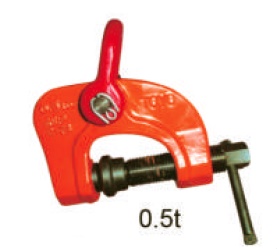 Lifting Clamp-STC for Clamp Family ReviewA lifting clamp model in the clamp family, placed after guidance on plate and bundle handling; review its details before matching to a specific lift.View Product →
Beam Clamps, Trolleys and Overhead Attachment
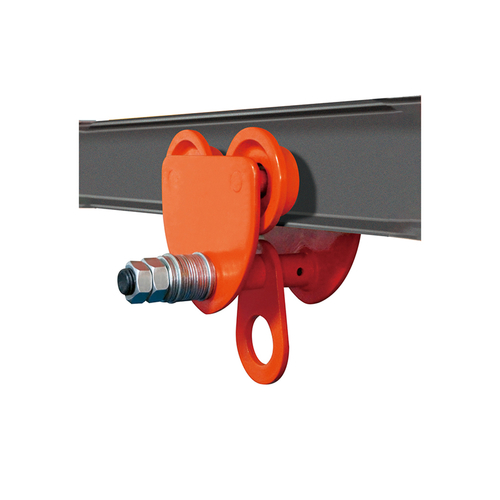
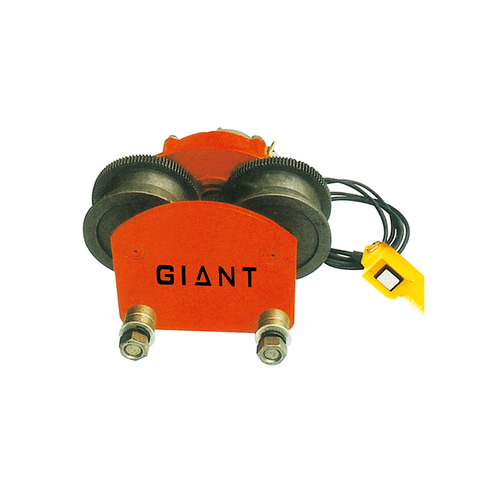
A beam clamp solves the opposite problem: it attaches the lifting point to the structure instead of the load. Selection depends on flange width range, flange thickness and working load limit, and the assembly is only as strong as the beam it hangs from. A 3 t clamp on a thin flange that deflects under load is not a 3 t system. When the clamp is combined with a trolley for horizontal travel, the beam profile matters too, because I-beam, H-beam and patented track have different flange shapes and need matching wheel profiles. For temporary work on an unknown or already modified beam, an adjustable portable gantry is often the more controllable choice.
 Beam Clamp-LJ-Q for Structural Lifting PointsA beam clamp model placed after flange and beam-profile selection guidance; check its compatibility and working load details before use.View Product →
Slings, Sling Angles and Rated Capacity
Sling capacity is quoted for a vertical lift with the load centered. The moment a sling runs at an angle, tension rises, and it rises faster than most people expect. The table shows what happens to each leg of a two-leg sling carrying a 1,000 kg load as the angle from horizontal falls.
| Angle from horizontal | Load on each leg | Increase over vertical |
|---|---|---|
| 90 degrees (vertical) | 500 kg | Baseline |
| 60 degrees | 577 kg | 15 percent |
| 45 degrees | 707 kg | 41 percent |
| 30 degrees | 1,000 kg | 100 percent |
| 20 degrees | 1,462 kg | 192 percent |
The practical rule is to keep sling angles at 60 degrees or more from horizontal wherever the geometry allows, and to read the tag instead of estimating. Chain slings tolerate heat and sharp edges better than webbing. Webbing and round slings are lighter and kinder to finished surfaces, but they need edge protection and must be kept clear of welding spatter. Any sling with cuts, broken stitches, stretched links or a missing tag goes out of service.
Crane Scales and Load Verification
Estimating a load is the most common route to an overload. A crane scale placed between the hook and the sling removes the guesswork, because the actual weight is visible before the load leaves the ground. Accuracy is usually quoted as a percentage of full scale, so a 5 t scale at 0.1 percent resolves roughly 5 kg, which is enough to catch a load that is 10 percent heavier than the drawing suggested. Look for a rotating swivel so the display can be read from the ground, a peak hold function, and battery life that covers a full shift. The scale is itself a load bearing device and needs its own WLL marking, calibration record and inspection interval.
 Industrial Crane Scale-OCS-D3 with Digital DisplayA crane scale model with zero, cumulative and keep functions, overload alarm and capacities from 1 to 20 T for suspended-load weighing.View Product →
Matching Attachments to the Hoist and the Load
Rated capacity travels in a chain, and the chain is only as strong as its lowest link. A 5 t hoist, a 3 t trolley, a 3.25 t shackle and a 2 t sling form a 2 t system, not a 5 t one. Build the number from the bottom up: start with the heaviest verified load, add the dynamic allowance the application needs, then select the attachment with the lowest WLL in the assembly and confirm the hoist is rated at least that high. The design factor built into hooks and slings, typically four to one or more, is a safety reserve and not capacity you can use.
Two more numbers are easy to forget. Headroom, because every shackle, scale and clamp in the assembly subtracts from the usable lift height. Duty, because a clamp used twenty times a day ages differently from one used twice a week, and the inspection interval should reflect that difference.
Inspection, Marking and Records
Inspection is where attachments earn their keep. A pre-use check is quick and covers the visible items:
- Latch function and freedom of movement on hooks
- Cracks, bends or throat deformation on hooks and shackles
- Worn or rounded teeth on clamps and grip surfaces
- Cuts, abrasion, heat damage or broken stitches on slings
- Legible tags showing WLL, grade and unique ID
Periodic inspection is more formal, and its frequency depends on duty cycle, environment and storage. A common baseline is every six months for normal use, more often for heavy, outdoor or corrosive conditions. Any item that has been overloaded, repaired or modified should be proof tested before it returns to service. For importers, the paperwork side matters as much as the hardware, since test certificates, material grades and marking that matches the destination market standard are usually the first thing a buyer checks.
Specifying Crane Attachments Before You Order
Four details prevent most disputes: the working load limit, the standard the item is made to, the surface or load type it will handle, and the marking and certificate that must ship with it. Finish matters as well, because galvanized chain and black oxide chain behave differently in coastal or humid storage, and the same applies to hooks, shackles and clamps. Consolidating hoists, clamps, slings and scales with one supplier that runs its own product development and quality inspection departments reduces the risk of a rating mismatch across the assembly and keeps the certificate trail in one place. That is the logic behind a catalogue covering lifting products, material handling, hydraulic and auto maintenance tools, and construction tools for buyers in more than 50 countries.
Attachments are the part of the lift that operators touch, adjust and sometimes improvise. Treating them as a system, with its own capacity chain, inspection schedule and documentation, is what keeps a lift predictable, whether it is a single 500 kg plate in a fabrication shop or a fleet of hoists and clamps moving through a port. Choose the attachment for the load, verify the load with a scale, and keep the paperwork with the hardware.