English
 Español

Content
- 1 Why Chain Slings Earn Their Weight
- 2 Choose the Grade Before the Sling
- 3 Finish and Heat: Where Capacity Quietly Disappears
- 4 Leg Configuration and the Capacity Math Buyers Get Wrong
- 5 Fittings Decide Whether the Sling Is Legal and Usable
- 6 Inspection: What to Measure and What to Reject
- 7 What to Ask Before You Place the Order
A six tonne bundle of hot rolled bar leaves the furnace at around 480 C. The two leg sling on the hook has to hold its rated capacity while the bar ends grind against the links, and it has to show a measurable stretch long before anything breaks. Chain is usually the only sling family that manages all three at once. Most chain sling problems in export orders, though, are not caused by wear. They start with a grade mismatch, a mode factor applied to the wrong angle, or a tag that disappeared two seasons ago. Four decisions decide the outcome: grade, finish, leg configuration and end fittings. All four are cheaper to settle at the quotation stage than at the inspection bay.
Why Chain Slings Earn Their Weight
Chain keeps its capacity on sharp edges, hot surfaces, abrasive grit and rough castings, where webbing and roundslings need extra sleeves or edge protection. The same assembly works as a straight lift on a machined shaft, a basket on a billet and a choker on a steel pipe. It also warns before it fails: grade 80 and grade 100 chain stretch visibly before fracture, so damage is local and assessable, and a sling can often be shortened or rebuilt instead of scrapped.
- Strong fit: foundries, steel stockyards, concrete yards, ship repair and outdoor sites with fixed lift geometry.
- Weaker fit: finished or painted surfaces that scratch easily, and tight spaces where a heavy assembly is a handling risk in itself.
Choose the Grade Before the Sling
Grade sets the capacity per link size and cannot be mixed inside one assembly. Grade 80 chain, specified in EN 818-2, is the general industry workhorse, rated with a design factor of 4 to 1 against the breaking load. Grade 100 uses higher strength steel and gives roughly 25 percent more working load limit in the same link diameter, which matters when the hook opening or the available headroom is the real constraint. Both grades are legitimate. What is not legitimate is grade 100 chain with grade 80 hooks, or a sling whose tag has been painted over.
| Link size | Grade 80 WLL | Grade 100 WLL | Typical use |
|---|---|---|---|
| 8 mm | 2.0 t | 2.5 t | Workshop and maintenance lifts |
| 10 mm | 3.15 t | 4.0 t | Fabrication, small plant |
| 13 mm | 5.3 t | 6.7 t | General structural steel |
| 16 mm | 8.0 t | 10.0 t | Heavy billets and concrete units |
| 20 mm | 12.5 t | 16.0 t | Foundry and mill duty |
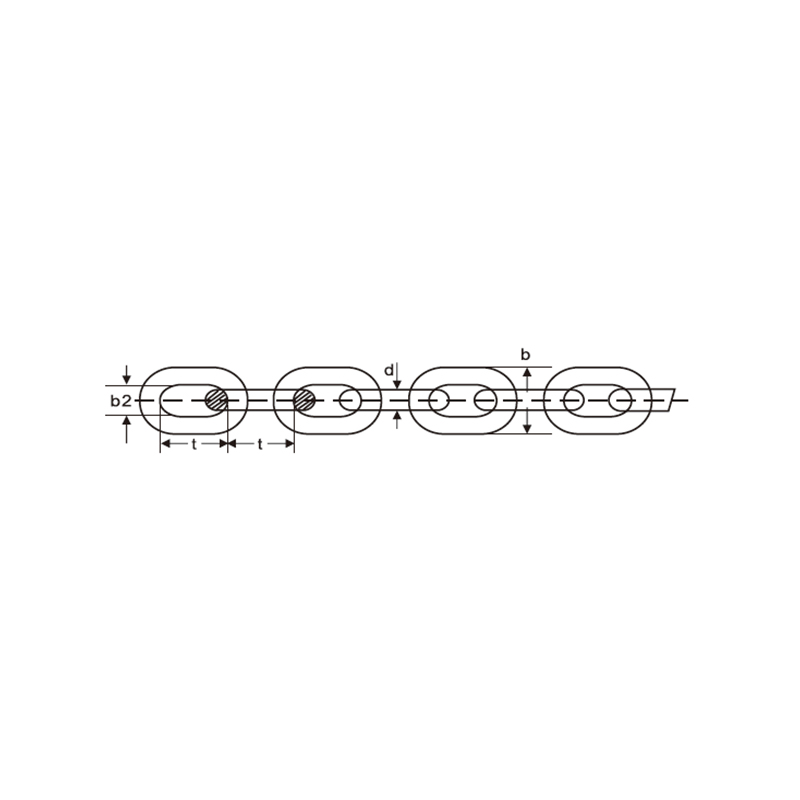 Grade 100 Black Oxide Lifting ChainGrade 100 black oxide chain in sizes from 6x18 mm to 16x48 mm, suited to industrial lifting where link size and headroom are constrained.View Product →
A 13 mm grade 100 single leg is rated at 6.7 t, which is why it turns up on press tooling and mould handling where a grade 80 sling of the same capacity would be 16 mm and would not fit the hook. If you are weighing grade against wear life, comparing chain materials explains how alloy content and heat treatment change strength and elongation.
Finish and Heat: Where Capacity Quietly Disappears
Finish is a purchasing decision with safety consequences. Hot dip galvanized chain suits outdoor yards, coastal air and wash-down areas, because the zinc layer takes the corrosion attack instead of the steel. Black oxide or self-coloured chain belongs indoors, where dimensional consistency and fast visual inspection matter more than weather resistance. Painted chain deserves scepticism: paint fills the nicks an inspector needs to see and often buries the grade mark.
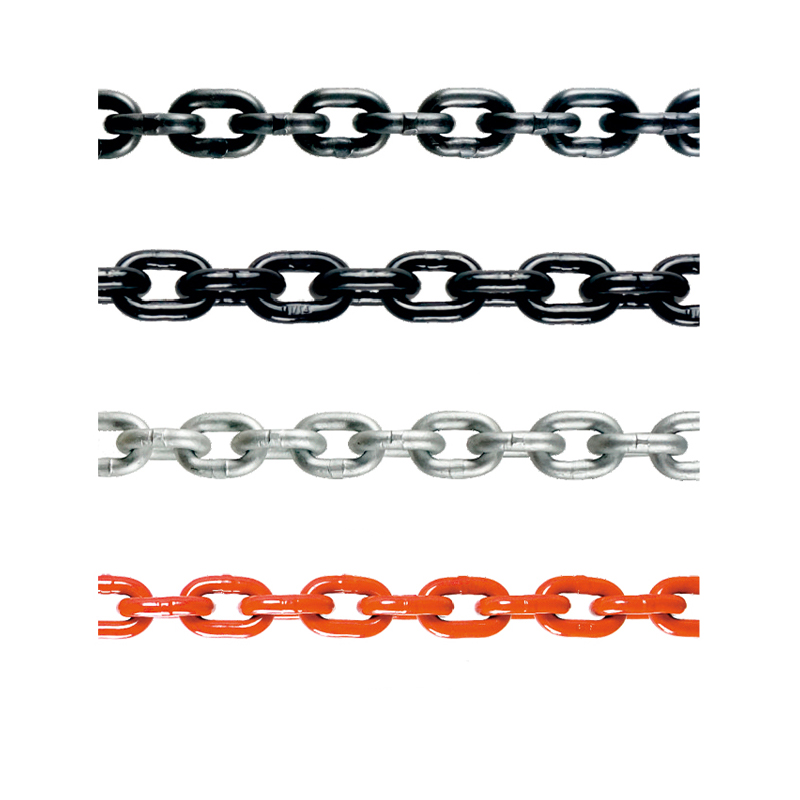 Galvanized Grade 80 Lifting ChainGalvanized G80 lifting chain for outdoor yards, coastal air and wash-down areas, available in sizes from 6x18 mm to 32x96 mm.View Product →
Temperature is the part buyers skip. A galvanized sling in a heat treatment shop is wrong twice over, because zinc and high temperature do not mix. A workable rule set used across the industry: no reduction up to 200 C, about 10 percent derating between 200 and 300 C, about 25 percent between 300 and 400 C with a documented engineering decision, and no chain slings above 400 C. Below minus 40 C, impact resistance falls, so avoid shock loading. Fittings must be rated for the same temperature as the chain, or the assembly rating drops to the weakest component.
Leg Configuration and the Capacity Math Buyers Get Wrong
The working load limit of a chain sling is not the sum of its legs. Each assembly carries a mode factor applied to the single leg capacity, and the angle is measured from the vertical, not from the horizontal. That single convention explains most on-site arguments: a two leg sling at 60 degrees has half the capacity of the same sling at 30 degrees.
| Configuration | Mode factor | Note |
|---|---|---|
| Single leg, straight | 1.00 | Reference capacity |
| Two leg, 0 to 45 degrees | 1.40 | Symmetrical loading |
| Two leg, 45 to 60 degrees | 1.00 | No gain over one leg |
| Three or four leg, 0 to 45 degrees | 2.10 | Rated on three legs only |
| Three or four leg, 45 to 60 degrees | 1.50 | Wide angles cost capacity |
| Choke hitch, single leg | 0.80 | Choke also wears the link |
Two consequences follow. A four leg sling is rated on three legs, because a rigid load never shares load evenly across four, which is why the factor is 2.1 and not 2.8. And a 13 mm grade 80 two leg sling gives 5.3 x 1.4, or 7.4 t, at 40 degrees but only 5.3 t at 55 degrees. Off-centre gravity centres reduce capacity further, so mark the lifting points and keep the hook over the centre of mass.
Fittings Decide Whether the Sling Is Legal and Usable
Four components sit between the crane hook and the load: master link, chain, coupler or shortening clutch, and terminal fitting. Any one of them at a lower grade sets the rating for the whole assembly, so specify the complete component list rather than a chain length. Hooks need a working latch, a throat opening that has not spread and a saddle that carries the load; a hook loaded on the tip is a bent hook waiting to happen.
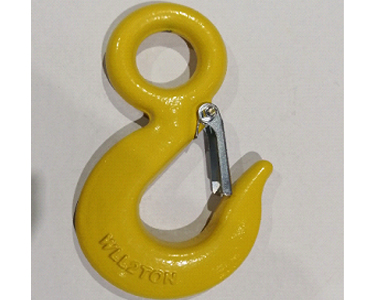 Hook-320AC Eye Hoist Hook with LatchForged, quenched and tempered eye hoist hook with latch, offered in carbon steel up to 15 tons and alloy steel up to 22 tons.View Product →
Shortening clutches pay for themselves on any sling used at more than one height. Couplers and master links must carry the same grade mark as the chain, and an unmarked coupler turns the assembly into scrap. One distinction catches new buyers: DIN 763 and DIN 766 link chain is general purpose chain for barriers, mooring and transmission, not a rated lifting sling. It photographs well and costs far less, and it should never be built into a sling.
Inspection: What to Measure and What to Reject
Inspection is where buyers find out whether the paperwork was real. The tag should show working load limit, grade, manufacturer, serial number and date of manufacture, backed by a certificate traceable to a heat number. Pre-use checks take a minute: run the chain through gloved hands, look for bent or twisted links, test the latch, read the tag. Thorough examination is normally at least every six months, and more often in abrasive, corrosive or heat exposed service.
| Condition | Limit or action |
|---|---|
| Link wear, reduced diameter | More than 10 percent of nominal: withdraw |
| Elongation of link or assembly | More than 5 percent, or chain no longer fits the gauge: withdraw |
| Cracks, deep nicks, gouges | Withdraw; no field welding or repair |
| Bent or twisted links, master link | Withdraw and replace the component |
| Hook throat opening | Increase above 10 percent, bent shank or missing latch: withdraw |
| Tag or grade mark unreadable | Withdraw until the assembly is identified |
What to Ask Before You Place the Order
Five questions remove most of the risk, and all five belong in the quotation, not the claim:
- Which grade is the chain, and is that grade marked on hooks, couplers and master links too?
- Which standard and mode factors appear on the tag, and does the tag state the angle range?
- Does the certificate trace to a heat number and match the tag serial number?
- Does the finish suit the site, and does the lift point temperature stay inside range for that finish?
- Can the sling be repaired locally with same grade links, hooks and couplers?
Answer those and the specification writes itself: grade 80 for general work, grade 100 where hook opening or headroom is tight, galvanized for outdoor and wash-down duty, black oxide for dry indoor service, with a full set of same grade fittings and a tag that survives its first year. Buyers who want to check ratings side by side can browse the lifting and rigging range before signing off.